
Analysts say Seoul is ready to take on more defense responsibilities as OPCON transfer advances
 |
Jennifer Kavanagh, senior fellow and director of military analysis at Defense Priorities./Defense Priorities |
As the Pentagon prepares to unveil its next National Defense Strategy as early as August, two U.S. defense analysts are urging a dramatic downsizing of American military presence in South Korea — a shift one expert believes could happen within four years.
In a new joint report, Dan Caldwell, a former senior adviser to Defense Secretary Pete Hegseth, and Jennifer Kavanagh, a senior fellow at the Washington-based think tank Defense Priorities, recommend withdrawing most of the roughly 28,500 U.S. troops currently stationed in South Korea. Their proposal: retain only about 10,000 troops, largely for strategic support functions.
The suggestion reflects a growing view within Washington that long-standing U.S. troop deployments in East Asia may no longer align with the country’s broader national security interests — and that a more agile, “strategically flexible” posture may now be necessary.
“The drawdown of U.S. troops in Korea is part of a broader trend — one that goes beyond Trump-era foreign policy,” Kavanagh said in a phone interview with The Chosun Ilbo on July 9. “Even if the final number is smaller than what we’ve proposed, I believe some level of withdrawal is realistic within four years. Over the long term, the U.S. could substantially reduce its military presence on the peninsula.”
Kavanagh, a veteran of the RAND Corporation and the Carnegie Endowment for International Peace, currently directs military analysis at Defense Priorities.
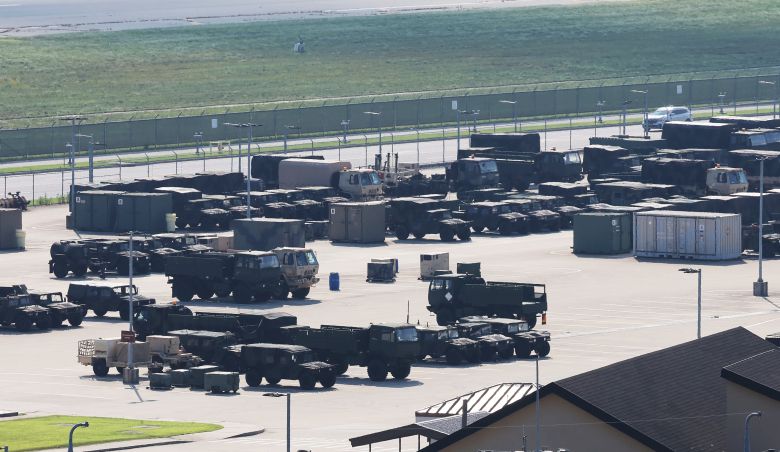 |
Vehicles are seen lined up at Camp Humphreys, a U.S. military base in Pyeongtaek, South Korea./U.S. Forces Korea |
Why now?
“The Pentagon is reassessing the global posture of U.S. forces, and as it prepares a new defense strategy, we hope our recommendations will help shape the conversation. Washington remains committed to its defense pledges to allies, but there is a clear desire for those allies to shoulder more of the burden — both financially and militarily. That will likely be reflected in the upcoming strategy. The debate in D.C. is centered on how the U.S.-South Korea alliance can best serve American interests: whether that means Seoul taking on more defense responsibility or whether U.S. bases in Korea can be used more flexibly to support wider operations across the Indo-Pacific.”
But doesn’t South Korea already spend more than most allies on defense?
“Absolutely. South Korea has been one of the most serious among U.S. allies in investing in its defense. It deserves credit for that. It is also well-positioned to counter North Korea’s conventional forces — probably better positioned than anyone else, short of nuclear deterrence. If South Korea continues to invest in ammunition stockpiles and advanced systems, it can assume even more responsibility for its conventional defense. The ongoing discussions around wartime operational control (OPCON) transfer may be an early step toward a reduction in U.S. ground forces.
What posture changes might the Pentagon consider?
“South Korea is geographically vital to U.S. strategy, and the Pentagon will have to think carefully about how its bases there could be used in future Indo-Pacific operations. But there are constraints. The number of troops the U.S. could rapidly redeploy from Korea in a crisis is limited, and it’s not guaranteed that American bases in South Korea would be available for operations elsewhere. To keep nearly 30,000 troops forward-deployed in one theater without clear flexibility is a risk for the U.S. military. That’s why I believe the Pentagon will scrutinize this posture closely.”
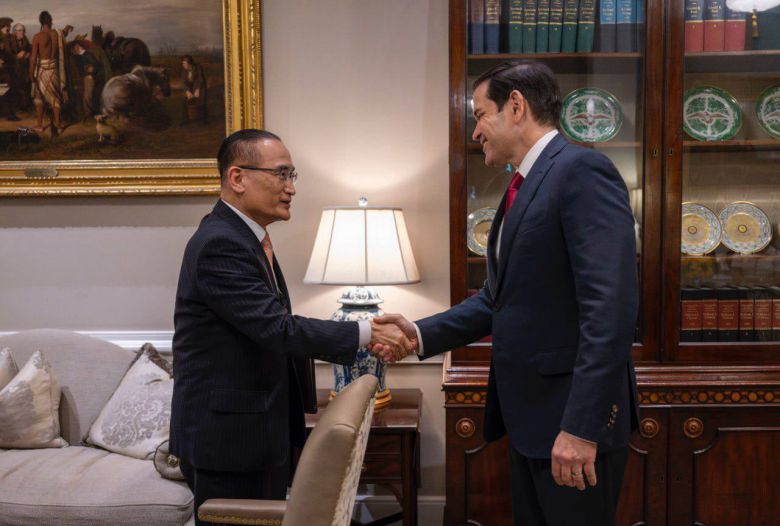 |
Wi Sung-lac, South Korea’s national security adviser, shakes hands with U.S. Secretary of State and National Security Adviser Marco Rubio during a meeting in Washington on July 7, 2025./South Korean Presidential Office |
What role does the U.S. envision for South Korea in a Taiwan contingency?
“In the event of a Taiwan crisis, the U.S. would likely want to use bases in Korea to launch contingency operations — for instance, flying missions to defend Taiwanese airspace or conducting strikes in the Yellow Sea (West Sea). But there’s no guarantee that South Korea would approve such actions. That’s why it may be more feasible to reconfigure those bases to focus on support roles like logistics, maintenance, and intelligence — roles that are less politically sensitive but still crucial.”
Is a U.S. withdrawal from Korea truly possible?
“Yes. Even if it doesn’t happen at the scale we’ve proposed, some reduction is quite plausible within the next four years. We’re not calling for U.S. withdrawal everywhere. But long term, I do believe the U.S. will sharply reduce its footprint in Korea. That reflects not just Trump-era thinking, but a deeper realignment in American foreign policy. Over the past several months, we’ve seen this shift emerge more clearly — in Europe, and increasingly in Asia.”
Would this mean walking away from U.S. defense commitments to South Korea?
“We’re not suggesting that the U.S. would abandon South Korea in the event of war. We believe the U.S. would still deploy reinforcements and offer air support if needed. But the expectation should be that South Korea defends its own frontlines.”
How should South Korea respond to Trump’s renewed demands for higher defense contributions?
“My advice to South Korean leaders would be the same as I give to European ones: start planning now for the possibility that you may need to defend yourself without American help. Identify where you are most dependent on U.S. support, and invest in those areas. That would signal a genuine commitment to burden-sharing and help sustain the alliance over the long term.”
[Kim Eun-joong (Washington)]
- Copyrights ⓒ 조선일보 & chosun.com, 무단 전재 및 재배포 금지 -
 이 기사의 카테고리는 언론사의 분류를 따릅니다.