
 |
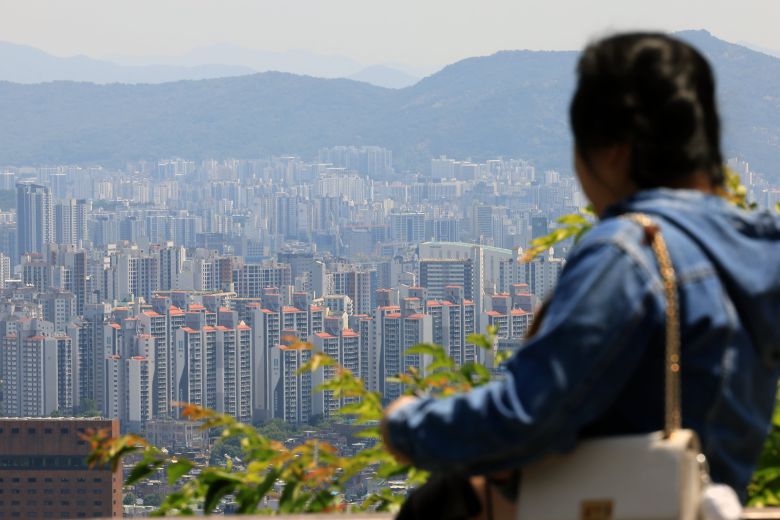
Apartments in Seoul are seen from Namsan on June 12. Seoul’s housing prices mark their 19th straight week of gains. /News1 |
Apartment prices in Seoul are rising at a troubling pace, intensifying concerns over the government’s ability to contain the surge. According to the Korea Real Estate Board, apartment sale prices in the capital climbed 0.26% in the second week of June from the previous week—the sharpest weekly increase since August last year. Home prices in the city have now risen for 19 consecutive weeks. The upward momentum, once concentrated in affluent districts such as Gangnam, is showing signs of spreading to northern Seoul and even into neighboring Gyeonggi-do.
In response, the government convened an emergency meeting to assess market conditions, concluding that the situation in Seoul’s housing sector has reached a serious level.
Analysts attribute the renewed spike in demand to buyers rushing to secure mortgages before tighter lending regulations come into effect next month. Compounding the issue is a persistent public perception that housing prices tend to climb under progressive governments—a view shaped by previous cycles. Critics argue that real estate policies focused on regulation have historically backfired, inadvertently pushing prices higher.
A case in point was the Moon Jae-in administration’s approach, which imposed heavier taxes on owners of multiple properties. The measure led many to consolidate holdings into a single high-value unit—a strategy known locally as “smart one-home”—further inflating prices in areas like Gangnam. Learning from this policy misstep, President Lee Jae-myung has pledged not to use tax hikes as a means of controlling property prices, a stance widely viewed as a sound departure from past practices.
Yet the broader economic landscape complicates the government’s challenge. With growth stalled, fiscal stimulus appears inevitable. However, fears are mounting that a fresh wave of liquidity could flow disproportionately into real estate, accelerating the upward pressure on prices. Market expectations of interest rate cuts later this year are fueling further anxiety, raising concerns that monetary easing could ignite an already overheated housing market.
Bank of Korea Governor Rhee Chang-yong has acknowledged the need for economic support measures but warned against the potential fallout. “If we lower the benchmark interest rate too much, it may not help the real economy recover but instead accelerate the rise in property prices in the Seoul metropolitan area,” he said. “If we rely too heavily on stimulus just because of urgency, the consequences could be more damaging in the long run,” he added.
In South Korea, many households have a single home as their primary or sole asset. Significant debt is often incurred to purchase property, with expectations of future price gains placing additional strain on household finances. Capital continues to be funneled into non-productive real estate, diverting resources away from sectors that support sustainable economic growth. The deepening gap in property values is also emerging as a threat to social cohesion.
The government’s ability to strike a balance between economic recovery and housing market stability is now under scrutiny. Revitalizing capital markets to channel funds into the real economy rather than real estate may offer one solution. In the long term, dislodging the deeply rooted belief that wealth creation hinges on home ownership will be essential to achieving market stability and social equity.
[The Chosunilbo]
- Copyrights ⓒ 조선일보 & chosun.com, 무단 전재 및 재배포 금지 -
 이 기사의 카테고리는 언론사의 분류를 따릅니다.