
Non-alcoholic beer sales jump 9% while traditional alcohol consumption declines 1% worldwide
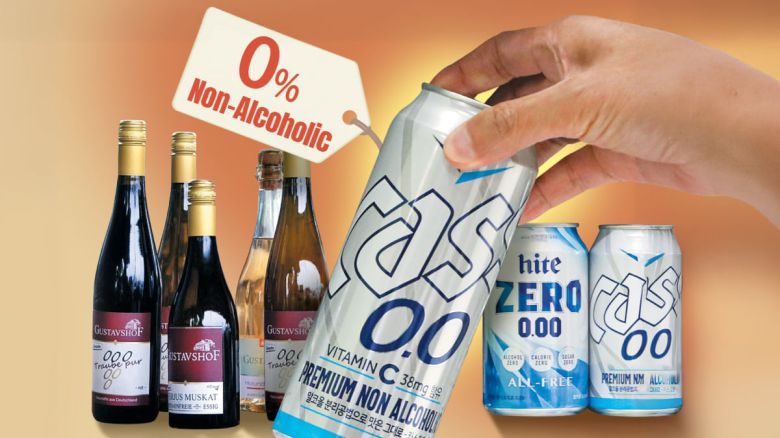 |
Non-alcoholic champagne brands, left, and non-alcoholic beer brands./Graphics by Yang In-sung |
At after-work dinners in Seoul, Ha, a 32-year-old employee at a securities firm, always orders non-alcoholic beer. “I do not enjoy drinking, so I usually avoid company gatherings,” Ha said. “But when I have to attend, I order non-alcoholic beer.”
Kim, a 52-year-old executive at a major South Korean conglomerate, said, “In the past, junior staff would sometimes bring non-alcoholic beer from a convenience store, saying they had a health checkup the next day or had just had a wisdom tooth removed. Now, they order it at restaurants without hesitation.”
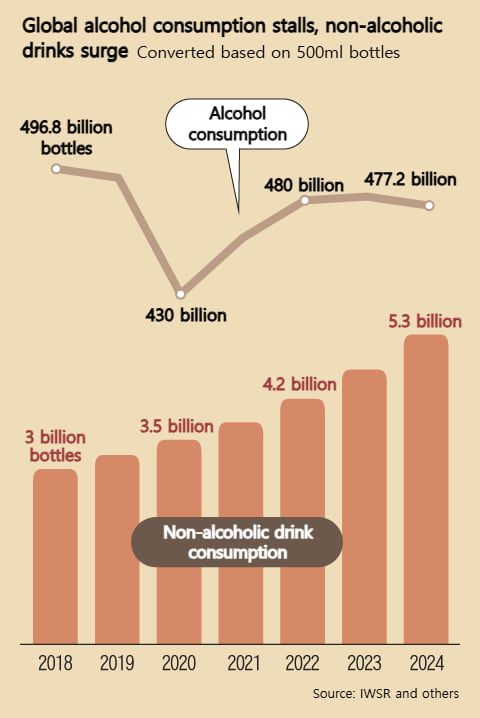
The rising preference for non-alcoholic beer is starting to reshape the global alcoholic beverage market. According to British market research firm IWSR, non-alcoholic beer is expected to surpass ale this year, becoming the world’s second most consumed beer category after lager. Sales of non-alcoholic beer grew 9% last year, while overall global alcohol consumption fell by 1%.
Experts attribute this market shift largely to millennials and Generation Z, whose focus on health and moderation is driving down demand for traditional alcohol while boosting the growth of alcohol-free options.
 |
Graphics by Yang In-sung |
Global alcohol sales reached about 477.2 billion 500-milliliter bottles last year, down about 4% from 496.8 billion bottles in 2018. In contrast, the market for non-alcoholic beverages is seeing rapid growth.
Last year, Germany’s Oktoberfest offered non-alcoholic beer for the first time. AB InBev, the world’s largest brewer, signed a sponsorship agreement with the International Olympic Committee ahead of the 2024 Paris Olympics. It was the first such deal for a global beer company, and the featured product was Corona Cero, a non-alcoholic beer. Japan’s Asahi Group also plans to double the share of its non-alcoholic and low-alcohol products, which contain 3.5% alcohol by volume or less, from 10% in 2023 to 20% by 2030.
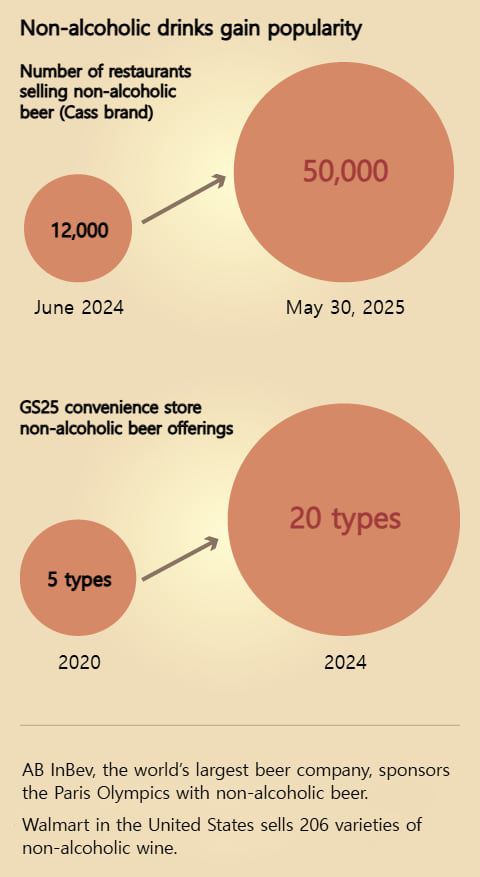
In South Korea, non-alcoholic beer is rapidly gaining popularity. Convenience store chain GS25 increased its non-alcoholic beer selection from five products in 2020 to 20 last year. By late May this year, more than 50,000 restaurants nationwide were serving non-alcoholic beer, up from 12,000 in June last year.
The non-alcoholic trend is expanding beyond beer into categories like wine, tequila, and whiskey. When Lotte Mart opened its new store in Seoul this January, it created a dedicated section for non-alcoholic wine, stocking more than 10 varieties. In the United States, where the market is even larger, Walmart offers 206 types of non-alcoholic wine. Luxury conglomerate LVMH invested in French Bloom, a non-alcoholic wine label, in October last year. Global spirits giant Diageo has acquired Ritual Zero Proof, a company that produces alcohol-free whiskey and tequila.
 |
Graphics by Yang In-sung |
The rapid growth of the non-alcoholic market is driven largely by millennials and Generation Z worldwide. A recent survey by Heineken Korea of 500 Koreans aged 20 to 39 found that 56.4% drink non-alcoholic beer even without specific reasons like driving or work. While non-alcoholic drinks were once mainly chosen by those who could not consume alcohol for health or other reasons, they are now becoming a popular choice among regular drinkers as well. At Emart, one of South Korea’s largest retailers, sales of non-alcoholic beverages from Jan. 1 to June 18 increased by 31.8% compared to the same period last year.
[Seok Nam-jun]
- Copyrights ⓒ 조선일보 & chosun.com, 무단 전재 및 재배포 금지 -
 이 기사의 카테고리는 언론사의 분류를 따릅니다.