
This article was released as Pharm Edaily Premium Content on January 8, 2026, at 8:00 AM.
[Kim Jinsoo, Edaily Reporter] Anticipation is building across South Korea’s pharmaceutical and biotech sector ahead of the annual J.P. Morgan Healthcare Conference (JPMHC) one of the industry’s biggest global gatherings. Shares of Samsung Biologics a regular on JPMHC’s official invitation list climbed on expectations tied to its main stage presentation. OliX also advanced on hopes for additional partnering outcomes.
CuroCell rose on expectations that its CAR-T therapy Rimcato (anbal cel) could win marketing approval within the first quarter, potentially becoming the first domestically approved CAR-T treatment in South Korea. Lunit fell sharply amid controversy related to fundraising reports which the company disputed.
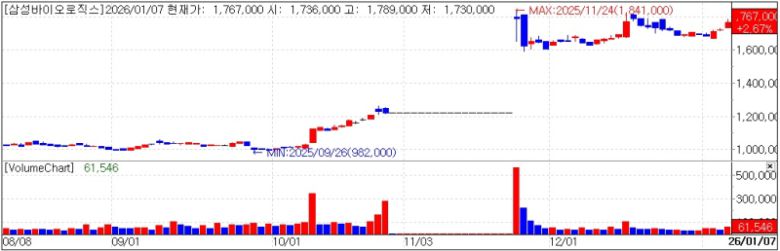 |
Samsung Biologics stock trend. (KG Zeroin) |
Samsung Biologics, OliX gain on JPMHC participation
According to KG Zeroin’s MP Doctor (formerly MarketPoint), Samsung Biologics shares closed up 2.67% at 1,767,000 won on Wednesday. From the close on Jan. 5, the stock has gained about 4.99%, the data showed. The rise is widely attributed to investor expectations ahead of next week’s JPMHC.
Held each January in San Francisco, JPMHC is the largest investment conference in the global pharmaceutical and biotech industry. Samsung Biologics has received an official invitation for 10 consecutive years since 2017, and this year it will again present on the conference’s main stage - a venue reserved for 25 selected companies.
Speaking slots are assigned based on industry significance, and Samsung Biologics is scheduled to present on the conference’s second day alongside major global drugmakers such as GSK, AstraZeneca and Eli Lilly.
Samsung Biologics plans to highlight its newly launched contract manufacturing (CMO) brand, “ExellenS,” along with last year’s performance and its growth strategy anchored on three pillars production capacity, portfolio and global footprint.
ExellenS is built around two core values equivalency and speed and is designed to supply biologics quickly with consistent quality through accumulated manufacturing know-how and standardized processes.
In the company’s framing, “equivalency” refers to establishing optimized manufacturing designs based on accumulated expertise and applying them to future facilities to ensure consistent quality and operations across plants. “Speed” reflects an agile production system intended to deliver medicines rapidly when global customers need them, based on optimized designs and operating processes.
Market attention toward Samsung Biologics is also expected to persist following the formal enactment of a U.S. “biosecurity” law aimed at restricting business with certain Chinese biotech companies, the article said.
OliX shares rose 9.38% to close at 158,600 won, driven by news of its JPMHC participation as well as plans to attend partnering programs and meetings hosted by global drugmakers.
OliX said it is actively pursuing additional technology licensing and joint research partnerships centered on its platform technologies targeting adipose tissue and the central nervous system (CNS), as well as its age related macular degeneration (AMD) candidate OLX301A.
The company also plans to pursue partnerships tied to its “OliX 2.0-CNS platform” including collaborations premised on its siRNA and blood-brain barrier (BBB) shuttle technologies. OliX said it aims to accelerate development of CNS targeted RNA therapeutics through detailed discussions on deal structure and execution.
“At this year’s JPMHC, we plan to fully introduce our OliX 2.0 platform strategy,” an OliX official said. “We will engage more actively in global out-licensing and co-development discussions and work to expand existing collaborations.”
CuroCell climbs on expectations for Korea’s first CAR-T approval
CuroCell shares closed up 8.48% at 55,000 won. The move was attributed to optimism around a potential first-quarter regulatory decision on marketing approval for Rimcato, the company’s lead candidate for relapsed or refractory large B cell lymphoma (LBCL).
A report from one brokerage said Rimcato’s application is moving through a “fast-track” process in which review by the Ministry of Food and Drug Safety and evaluations related to health insurance reimbursement and drug pricing negotiations are proceeding in parallel, increasing the likelihood of a first-quarter conclusion.
CuroCell submitted Rimcato’s marketing authorization application to the MFDS in December 2024. The same month, the therapy was selected for the second round of a pilot program for advanced biopharmaceuticals under the Ministry of Health and Welfare, enabling simultaneous review of approval reimbursement and pricing.
CuroCell points to its proprietary OVIS technology as a key differentiator. The approach suppresses expression of immune checkpoint receptors PD-1 and TIGIT to enhance CAR-T cell function a mechanism viewed as potentially improving treatment efficacy.
According to CuroCell’s final clinical study report for a Phase 2 trial, the complete response (CR) rate among patients treated with anbal cel was 67.1%. That compares favorably with complete response rates in the 40% range reported in pivotal studies of rival therapies that currently dominate the global market the company said.
“It’s difficult to predict the exact timing, but we expect a conclusion on approval within the first quarter,” a CuroCell official said.
Lunit slides amid fundraising controversy
Lunit shares fell 14.11% to close at 38,650 won, as investor sentiment weakened amid growing controversy over media reports about the size and terms of the company’s fundraising efforts.
A local media outlet reported Tuesday that Lunit had initially pursued fundraising of more than 200 billion won but that the amount had dropped to 80 billion won.
The report also cited Lunit’s issuance of 170 billion won in convertible bonds (CBs) in May 2024 and suggested that with put option exercise periods approaching in the first half of this year and an interest rate of 8% the company could face principal and interest repayments exceeding 200 billion won. The report said the company was pursuing efficiency measures across the board, including restructuring, hiring adjustments and a review of R&D spending.
Lunit pushed back, urging investors not to be swayed by what it described as exaggerated interpretations.
Lunit said it never pursued a 200 billion won fundraising plan. It added that discussions with investors had centered on 60 billion won to 80 billion won making the claim that it sought more than 200 billion won but raised less “inaccurate in itself.”
The company also said it cannot disclose details such as a finalized fundraising amount before completion because fundraising is material investment information subject to capital markets rules. Lunit said it will disclose the amount and purpose through an exchange filing once the fundraising is completed.
On the claim that put option exercise periods for the 2024 CBs are approaching Lunit said it has met with all bondholders and that all indicated they do not intend to exercise their puts. The company said it is pursuing the fundraising as an investment for the future and to secure a portion of contingency funds.
“We have already noted several times that we are working to reduce costs including workforce reductions to improve our financial position and return to profitability.” a Lunit official said. “These efforts are intended to strengthen our long-term growth foundation and maximize shareholder value. The term ‘emergency management’ overly distorts the company’s actual situation.”
 이 기사의 카테고리는 언론사의 분류를 따릅니다.