
Proposal mirrors Japan’s $400 billion fund; Seoul weighs limits
The United States has asked South Korea to lead the creation of a multi-billion-dollar investment fund aimed at bolstering American manufacturing, according to Korean government officials familiar with the discussions.
The fund, tentatively described as a “manufacturing cooperation enhancement fund,” would provide financing for Korean firms to build or expand factories in the U.S. or invest in local partners. The request, confirmed on July 15, marks a significant departure from earlier American demands centered on easing trade barriers in agriculture and digital data.
During recent tariff negotiations in Washington, U.S. officials floated the idea—modeled on a proposal from Japan—to establish a sovereign-style fund to support American industry. Japan is said to have suggested a $400 billion fund during its own bilateral trade talks. Given that South Korea and Japan run similarly sized trade surpluses with the U.S., Washington is reportedly expecting Seoul to offer a comparable commitment.
The fund, tentatively described as a “manufacturing cooperation enhancement fund,” would provide financing for Korean firms to build or expand factories in the U.S. or invest in local partners. The request, confirmed on July 15, marks a significant departure from earlier American demands centered on easing trade barriers in agriculture and digital data.
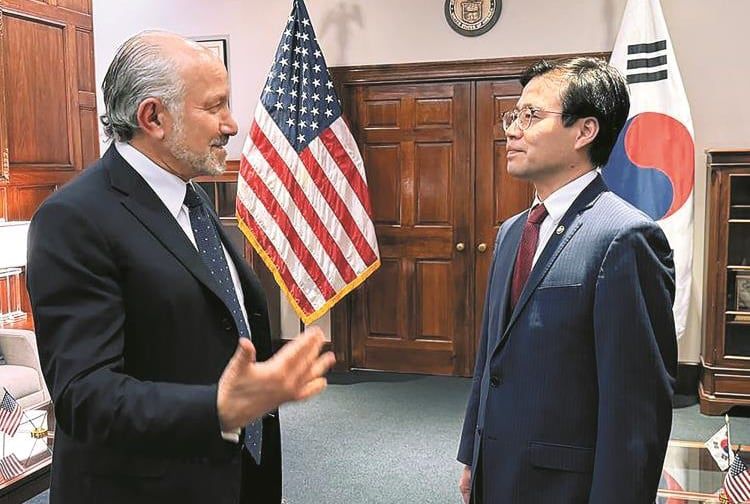 |
Yeo Han-koo, South Korea’s chief trade negotiator, meets with U.S. Commerce Secretary Howard Lutnick at the Commerce Department in Washington on July 7, 2025./Ministry of Trade, Industry and Energy |
During recent tariff negotiations in Washington, U.S. officials floated the idea—modeled on a proposal from Japan—to establish a sovereign-style fund to support American industry. Japan is said to have suggested a $400 billion fund during its own bilateral trade talks. Given that South Korea and Japan run similarly sized trade surpluses with the U.S., Washington is reportedly expecting Seoul to offer a comparable commitment.
The request comes just weeks ahead of an Aug. 1 deadline set by President Donald Trump, who has threatened to impose 25% reciprocal tariffs on goods from South Korea, Japan, and others unless significant progress is made. The fund is widely seen as a deliverable Trump could frame as a win for domestic manufacturing ahead of the election.
For Seoul, however, both the timing and the scale of the request pose major challenges. The proposed fund would exceed 80% of South Korea’s annual budget, prompting urgent debate over how it could be financed. Korean officials had already expressed frustration with U.S. demands during the talks, citing Commerce Secretary Howard Lutnick’s “unrealistic” expectations as a sticking point.
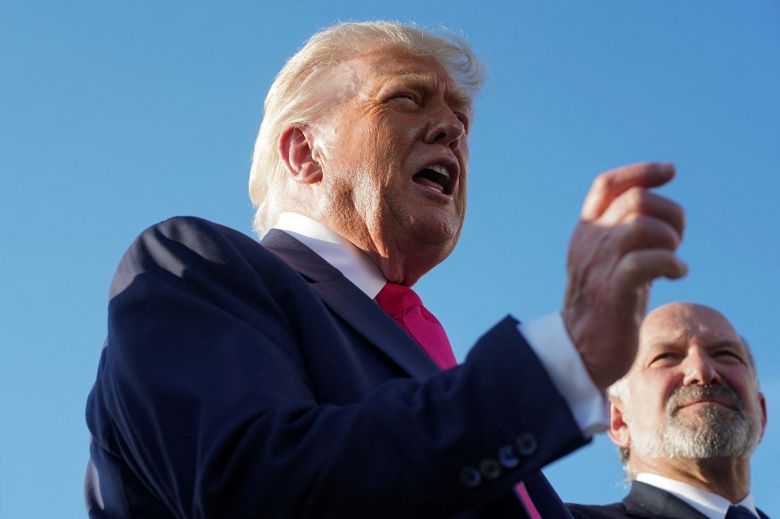 |
U.S. President Donald Trump speaks to reporters after arriving from Pennsylvania as Commerce Secretary Howard Lutnick looks on at Joint Base Andrews in Maryland on July 15, 2025./Reuters-Yonhap |
According to Korean sources, the fund was first raised in two high-level meetings held on July 7 and 10 in Washington. Yeo Han-koo, South Korea’s chief trade negotiator, met with Secretary Lutnick twice during that period and later said the two sides had engaged in “in-depth discussions” on manufacturing cooperation.
A senior Korean official said Seoul had prepared a range of trade concessions, including proposals to open up agricultural markets and relax digital map export restrictions. However, the U.S. side largely focused on the fund.
At a media briefing on July 14, Yeo alluded to the proposal without naming it directly. “When Korean companies invest in sectors like shipbuilding, semiconductors, and batteries—or purchase advanced U.S. equipment—it aligns with the broader goal of strengthening manufacturing ties,” he said. “While individual investment decisions belong to the private sector, the government’s role is to build a platform that supports and accelerates those decisions.”
He added that the goal is not simply to negotiate lower tariffs, but to pursue a “positive-sum outcome—helping revitalize U.S. manufacturing while creating new growth drivers for Korean firms.”
The idea of a government-backed outbound investment fund, tied to tariff relief, echoes Tokyo’s earlier strategy. According to a May report by the Financial Times, SoftBank founder Masayoshi Son privately discussed a U.S.–Japan sovereign fund with Treasury Secretary Scott Bessent. Originally floated at $300 billion, the plan reportedly grew to $400 billion during talks. Japan has sought tariff relief on automobiles and other key sectors in return.
Whether Seoul can offer a comparable package remains uncertain. Despite similar trade surpluses with the U.S., South Korea’s smaller economy and relatively lower levels of direct investment in the U.S. may make it difficult to match Japan’s scale. Offering a significantly smaller fund, however, could weaken its negotiating position.
Korean officials held internal talks on July 15 to assess possible fund sizes, financing mechanisms, and investment targets.
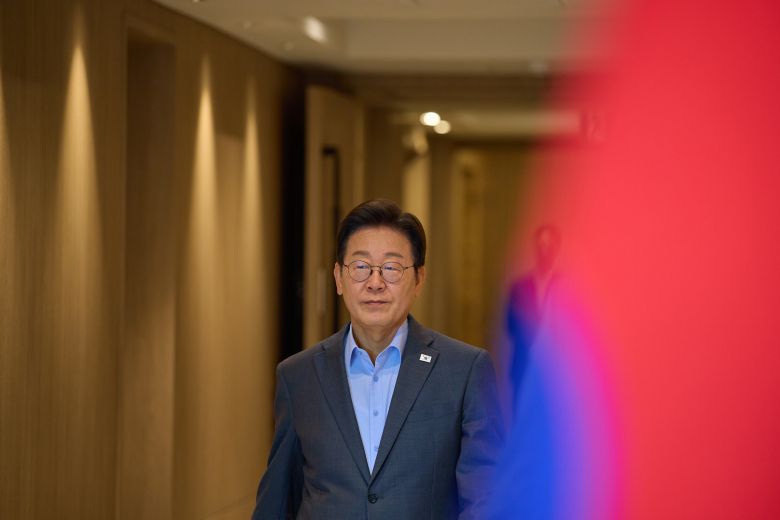 |
South Korean President Lee Jae-myung walks to a luncheon meeting with civic leaders at the presidential office in Yongsan, Seoul, on July 10, 2025./Presidential Office |
Some argue that even a partial commitment could help defuse tensions and support Korean firms’ strategic expansion into the U.S. market. With domestic demand stagnant and Chinese competition intensifying, overseas expansion is increasingly seen as essential to long-term growth.
“Korean companies are already shifting away from export-based models toward localized production,” said one trade expert, speaking on condition of anonymity. “Given that firms make investment decisions based on expected returns, creating a fund to support them is not merely a cost—it’s a strategic investment by the government.”
Still, some warn that such policies could accelerate “industrial hollowing out” at home, as capital and manufacturing capacity shift overseas.
The Korean government is now preparing to resume “2+2” trade talks—bringing together the ministries of finance and industry—as soon as newly appointed cabinet ministers are confirmed. The goal is to restart negotiations with Secretaries Bessent and Lutnick ahead of the August deadline.
But with Washington’s demands expanding—from agricultural liberalization to a massive industry fund—Korean officials privately acknowledge the road ahead will be difficult. Some concede the possibility that talks may miss the Aug. 1 deadline.
“We are not going to sacrifice substance for speed,” Yeo told reporters on July 14. “Rushing to meet the clock at the expense of national interest is not an option.”
[Choi Eun-kyung]
- Copyrights ⓒ 조선일보 & chosun.com, 무단 전재 및 재배포 금지 -
 이 기사의 카테고리는 언론사의 분류를 따릅니다.