
Once a tech powerhouse, the company’s internal rot is now driving its best engineers out the door
 |
Graphics by Son Min-gyun |
A growing number of engineers are walking away from Samsung Electronics Co., raising alarms over talent retention at South Korea’s most critical tech company as it navigates mounting global pressure in the semiconductor space.
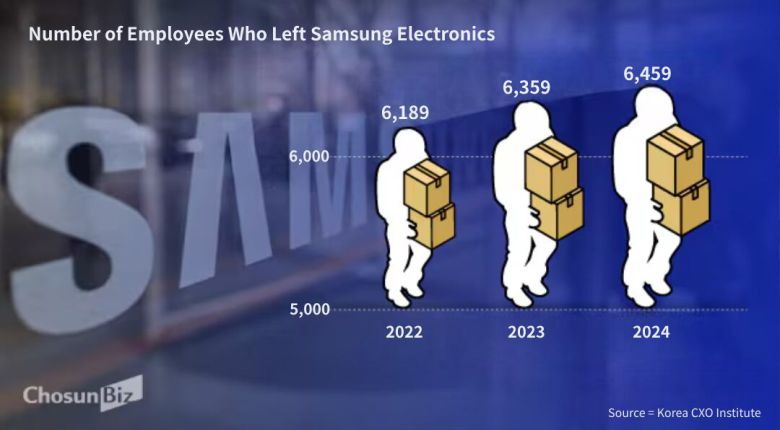
Employee departures at Samsung rose to 6,459 last year from 6,189 in 2022, according to internal data. While the overall increase appears modest, insiders say the real concern lies in the steady outflow of highly trained personnel—particularly master’s and Ph.D.-level engineers—from its Device Solutions (DS) division, the hub of Samsung’s chipmaking operations.
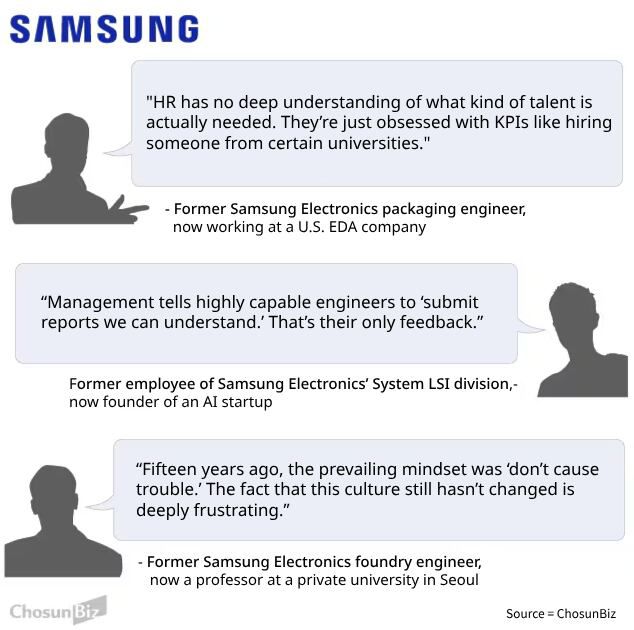
Interviews with former engineers conducted by ChosunBiz point to a common theme: dissatisfaction with an increasingly bureaucratic management structure, sluggish decision-making, and a top-down culture that many say is out of touch with the demands of high-stakes semiconductor development.
 |
Graphics by Son Min-gyun |
Much of the discontent traces back to 2017, the year former CEO Kwon Oh-hyun retired. His exit marked a shift in Samsung’s organizational dynamics. A centralized business support task force assumed control of HR and financial operations across DS, eroding the division’s traditional autonomy and replacing it with layers of executive approvals—even for R&D and capital investment.
C, 38, a KAIST-trained materials scientist who now works at SK hynix, said that structural issues worsened in the foundry unit after leadership realignments. “In the past, memory division staff were simply moved into foundry roles without proper understanding. Now, outsiders are brought in who don’t grasp the full manufacturing flow,” he said.
“Foundry work relies on coordination across process lines,” he added. “When leadership doesn’t understand that, bottlenecks emerge, and engineers pay the price.” He also cited persistent pay gaps and slower promotions compared to the memory business. “I felt undervalued. Leaving was the only logical choice.”
Leadership turnover and internal dysfunction surfaced repeatedly in interviews. D, a former principal researcher now in academia, said Samsung’s R&D culture hasn’t evolved in over a decade. “Executives rotate every few years. One year to learn the business, two years to get something going, and then they’re out. It’s a reset cycle that kills continuity,” he said. “That’s toxic for innovation.”
He described a workplace culture that punishes innovation and rewards conformity. “Fifteen years ago, you were told: ‘Don’t make waves.’ That’s still the rule.”
Another engineer, now working at a global EDA firm, pointed to deeper HR problems. A graduate of Seoul National University with advanced engineering degrees, he said, “Weak managers sideline strong engineers to protect their turf. HR is obsessed with prestige degrees, but they don’t understand the skill sets we actually need.”
 |
Samsung's Seocho office building in Seoul./Yonhap |
Former employees say these dynamics are undermining Samsung’s ability to compete in the fast-moving world of AI semiconductors.
E, who holds a Ph.D. from a U.S. university and previously worked on system chips at Samsung, now runs a startup. “AI innovation needs rapid iteration and decisiveness,” he said. “At Samsung, everything stalls. Promising chip designs got bogged down in funding approvals or scrapped outright. Great at mass production? Yes. But that’s not enough anymore.”
Other former executives argue the company’s prioritization of operational stability over strategic boldness has cost it leadership in key markets. One AI chip executive who spent nearly two decades at Samsung’s System LSI division recalled missed chances to expand beyond mobile processors.
“Qualcomm pivoted to cars and IoT. We didn’t,” he said. “We had modem IP and internal capabilities to go broader, but leadership kept playing it safe.”
“Developing IP is how you stay ahead of the curve,” he said. “We tried filing patents, designing new architectures—but all management cared about was whether they could understand the reports. That disconnect drove a lot of us out.”
Today, many of those engineers are now working for global players like Arm Holdings and Broadcom—often with better pay and more autonomy. For those still inside Samsung, the exodus continues to fuel doubts about the company’s future as an innovation leader in the age of AI.
[Hwang Min-gyu]
- Copyrights ⓒ 조선일보 & chosun.com, 무단 전재 및 재배포 금지 -
 이 기사의 카테고리는 언론사의 분류를 따릅니다.