
AI momentum, governance reforms boost long-term investment case
South Korea is poised to deliver the highest returns among emerging and Asian markets over the next 10 years, according to a senior portfolio manager at Morningstar Wealth.
Mark Preskett, a London-based fund manager at the investment arm of research giant Morningstar, told Bloomberg on July 9 that he has been selling Chinese and Japanese equities to increase exposure to South Korea, which he sees as offering the most attractive long-term opportunity.
Preskett cited technology stocks tied to the artificial intelligence boom and political momentum for corporate reform as key reasons behind his bullish stance. He forecasts annual dollar-based returns of 11% to 12% from Korean equities over the next decade.
Mark Preskett, a London-based fund manager at the investment arm of research giant Morningstar, told Bloomberg on July 9 that he has been selling Chinese and Japanese equities to increase exposure to South Korea, which he sees as offering the most attractive long-term opportunity.
Preskett cited technology stocks tied to the artificial intelligence boom and political momentum for corporate reform as key reasons behind his bullish stance. He forecasts annual dollar-based returns of 11% to 12% from Korean equities over the next decade.
Among individual names, Preskett is optimistic on SK Hynix Inc. and Samsung Electronics Co., both key suppliers of high-bandwidth memory chips essential for AI systems. Despite significant price gains this year—Samsung up 14%, SK Hynix up 62%—he believes both stocks remain undervalued.
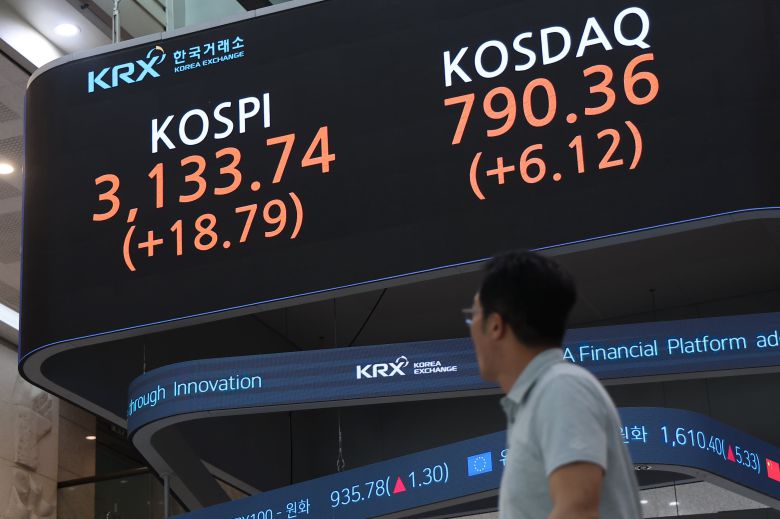 |
A screen at the Korea Exchange in Yeouido, Seoul, displays the benchmark KOSPI index on July 9, 2025. The index closed up 18.79 points, or 0.60 percent, at 3,133.74—surpassing the previous closing high for the year of 3,116.27 set on July 3./Yonhap |
“Korea stands out at the top in terms of expected returns,” he said in an interview with Bloomberg. “We see this as the beginning of a revaluation story.”
The outlook comes amid broader market skepticism following U.S. President Donald Trump’s recent announcement of a 25% tariff on Korean imports. But Preskett remains unfazed. He said he expects “some kind of agreement to be signed by the two countries in the coming weeks.” He also pointed to the absence of additional tariffs on autos, and the exemption of electronics and pharmaceuticals, as positives for Korea.
Preskett also expressed confidence in Seoul’s recent push to improve corporate governance through its “Value-Up” program. He noted that newly passed legal amendments aimed at strengthening minority shareholder rights and curbing the influence of family-run chaebols would further enhance Korea’s investment appeal.
He acknowledged that risks remain—particularly around implementation and company buy-in—but emphasized that structural changes underway signal a “long-term investment theme.” He also noted the current administration’s pledge for fiscal reform, which he said could benefit the consumer and banking sectors.
“For us, it is the start of a journey,” Preskett said. “We feel that it’s the tip of the iceberg in terms of flows and potential revaluation.”
[Lee Ka-young]
- Copyrights ⓒ 조선일보 & chosun.com, 무단 전재 및 재배포 금지 -
 이 기사의 카테고리는 언론사의 분류를 따릅니다.