
Labor ministry proposes five-phase rollout to make annuity-style retirement benefits standard across all workplaces
The South Korean government is pushing forward with a major overhaul of how workers receive retirement benefits, aiming to replace the longstanding lump-sum severance system with mandatory pension-style disbursements across all workplaces.
The Ministry of Employment and Labor has proposed a five-phase plan that would require all employers—beginning with large corporations and eventually extending to the smallest businesses—to transition to the retirement pension system. Once fully implemented, workers would no longer be able to receive their retirement pay as a one-time cash payment. Instead, benefits would be paid out as annuities, similar to the structure of the National Pension Service.
The proposal, presented recently to the Presidential Committee on Policy Planning, comes as retirement pension assets surpassed 431 trillion won (about $311 billion) at the end of 2024. If the current pace of growth continues, the pension fund could surpass the size of the National Pension Fund by 2050, according to government projections.
The Ministry of Employment and Labor has proposed a five-phase plan that would require all employers—beginning with large corporations and eventually extending to the smallest businesses—to transition to the retirement pension system. Once fully implemented, workers would no longer be able to receive their retirement pay as a one-time cash payment. Instead, benefits would be paid out as annuities, similar to the structure of the National Pension Service.
The proposal, presented recently to the Presidential Committee on Policy Planning, comes as retirement pension assets surpassed 431 trillion won (about $311 billion) at the end of 2024. If the current pace of growth continues, the pension fund could surpass the size of the National Pension Fund by 2050, according to government projections.
Officials say the transition would offer stronger financial protections for workers and help alleviate elderly poverty by promoting stable, long-term income streams. Unlike severance pay—often held in-house by companies and vulnerable to payment delays—pension funds must be deposited with external financial institutions, reducing the risk of non-payment.
 |
Illustrated by Rhee Chul-won |
To manage the transition, the government plans to establish a new Retirement Pension Service and offer targeted tax incentives to discourage early withdrawals. It is also exploring legal changes to make workers eligible for retirement benefits after just three months of employment, down from the current one-year minimum.
Recognizing the potential strain on smaller businesses, the ministry is considering a phased rollout based on company size—starting with firms of 300 or more employees and gradually expanding to businesses with fewer than five. While roughly 92 percent of large corporations already offer retirement pensions, the coverage rate drops to 41.4 percent among companies with 5 to 29 employees, and to just 10.4 percent at firms with fewer than five.
To ease the burden, the government plans to subsidize 10 percent of employer contributions for three years if small businesses adopt the system early. Still, business groups and employers warn the proposed changes could impose steep new costs, especially amid rising wages and labor standards.
 |
A view of the Ministry of Employment and Labor building at the Sejong Government Complex in Sejong./News1 |
Under the current system, companies can choose between paying a lump-sum severance or offering a defined-contribution pension. The proposed reform would eliminate the severance option altogether, standardizing pensions as the sole method of retirement benefit disbursement.
To prevent early withdrawals—which are legally permitted in cases like home purchases or family emergencies—the ministry is weighing additional tax incentives for long-term savers. One idea under discussion is to offer enhanced benefits to workers who remain enrolled for over 20 years without tapping their funds. Another proposal would grant youth-specific tax credits to encourage early participation.
“A retirement pension is a form of deferred compensation for work already performed,” a ministry official said. “We can’t prohibit early withdrawals entirely, but we can encourage long-term participation through smart tax policy.”
The ministry is also considering loosening investment restrictions for retirement pensions. Specifically, it is exploring ways to allow pension funds to invest in domestic venture companies and private startups—currently off-limits under regulations that treat pension contributions as wage extensions rather than public assets.
Experts say the reform could boost both pension returns and venture capital availability. According to the Ministry of SMEs and Startups, South Korean venture investment totaled 11.9 trillion won in 2024. If retirement pensions are allowed into the market, the available capital could increase substantially.
The government aims to revise the relevant regulations under the Act on the Guarantee of Employees' Retirement Benefits by 2027.
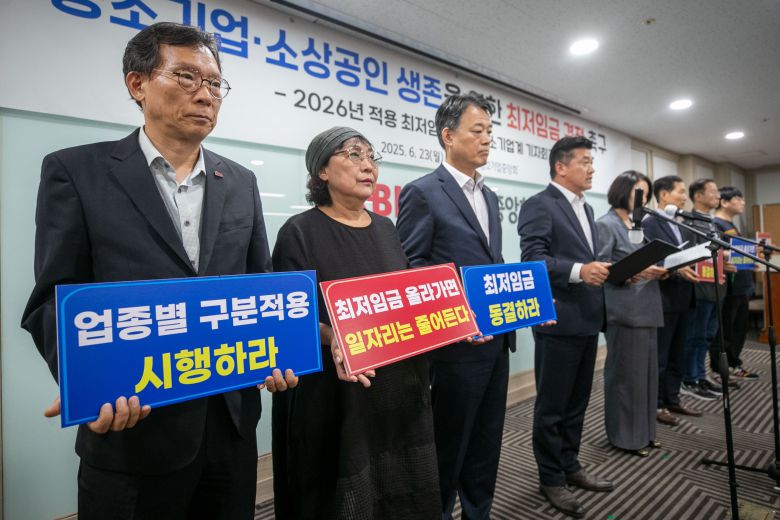 |
Participants hold signs calling for a freeze on the minimum wage during a press conference by South Korea’s small and medium-sized business community on the 2026 minimum wage, held at the Korea Federation of SMEs in Yeouido, Seoul, on June 23, 2025./Chang Lian-cherng |
One of the more contentious aspects of the proposal is the plan to lower the eligibility threshold for retirement benefits from one year to just three months of employment. Officials say the change is designed to expand protection for temporary or gig economy workers, who often rotate through short-term jobs without accumulating any retirement benefit.
Critics argue the measure could significantly increase costs for employers and dilute the original purpose of retirement pay, which was designed to reward long-term service.
“There are limits to what small companies can absorb,” one business executive said. “Linking short-term employment to guaranteed pension rights could open the door to legal challenges and increase labor mobility in ways that undermine long-term loyalty.”
The labor ministry acknowledged those concerns in its policy briefing. “There are legal and financial issues surrounding the nature of severance pay,” the report said. “A national dialogue is needed to build consensus, particularly with small and mid-sized employers.”
[Kim Asa]
- Copyrights ⓒ 조선일보 & chosun.com, 무단 전재 및 재배포 금지 -
 이 기사의 카테고리는 언론사의 분류를 따릅니다.