
 |
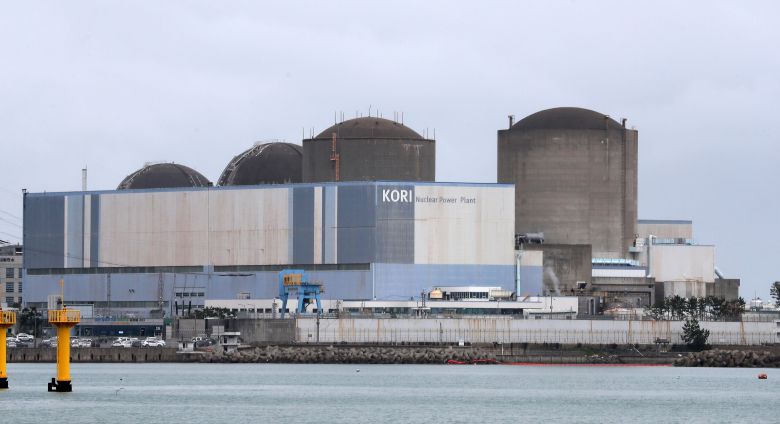
A view of the Kori Nuclear Power Plant. From right: Units 1, 2, 3, and 4. /News1 |
A decision on whether to approve the decommissioning of Kori Unit 1 is scheduled for June 26, a move that could inject new momentum into South Korea’s nuclear decommissioning industry. The process involves permanently shutting down a nuclear power plant, dismantling its structures and systems, and eliminating radioactive contamination from the site.
According to the nuclear energy sector on June 19, the Nuclear Safety and Security Commission (NSSC) plans to include the Kori Unit 1 decommissioning approval on the agenda for its upcoming plenary session. If granted, it would mark eight years since the facility was permanently shut down in June 2017. Korea Hydro & Nuclear Power (KHNP), the plant’s operator, submitted its decommissioning application on May 14, 2021.
KHNP included its Final Decommissioning Plan with the application. After the Korea Institute of Nuclear Safety (KINS) completed a documentation review, a full technical assessment began in February 2022 and spanned three years. “The review process lasted three years,” a KINS official said. “Since February this year, the results have been under evaluation by the NSSC’s panel of nuclear safety experts.”
As of May, 214 reactors across 22 countries had been permanently shut down. Of those, only 25 have been fully dismantled. The United States leads with 20, followed by Germany with three, and Japan and Switzerland with one each. Another 189 reactors remain in a state of permanent shutdown awaiting dismantling. As more reactors reach the end of their operational lifespan, the global nuclear decommissioning market is expected to expand significantly, with estimates projecting the sector will be worth as much as 500 trillion won by 2050.
Decommissioning is viewed as a long-term, stable revenue stream. The full cycle typically spans 15 years: two years of pre-shutdown preparation, five years for safety management and spent fuel removal, six years for dismantling, and two years for site restoration.
The South Korean nuclear industry views Kori Unit 1’s decommissioning as a potential springboard into the global market. While South Korea is recognized for its competitiveness in nuclear plant construction, it has yet to establish a track record in decommissioning. In contrast, the United States, with 20 dismantled reactors, has at least two companies that specialize in the field.
To prepare for market entry, South Korean institutions have been developing relevant technologies. KHNP has secured 58 commercial-grade decommissioning technologies, including structural diagnostics for dismantling facilities, while the Korea Atomic Energy Research Institute (KAERI) has independently developed 38 foundational technologies. “While some gaps remain compared to advanced nuclear countries, KHNP is seen as having secured all core technologies necessary for decommissioning,” an NSSC official said.
At the June 26 plenary session, the NSSC is expected to review safety measures related to potential accidents during dismantling. Under the Enforcement Decree of the Nuclear Safety Act, decommissioning approval requires that operators possess the necessary technical capabilities, submit a sound decommissioning plan, and implement measures to manage radiation exposure and ensure compliance with regulatory dose limits.
[Lee Jong-hyun]
- Copyrights ⓒ 조선일보 & chosun.com, 무단 전재 및 재배포 금지 -
 이 기사의 카테고리는 언론사의 분류를 따릅니다.