 |
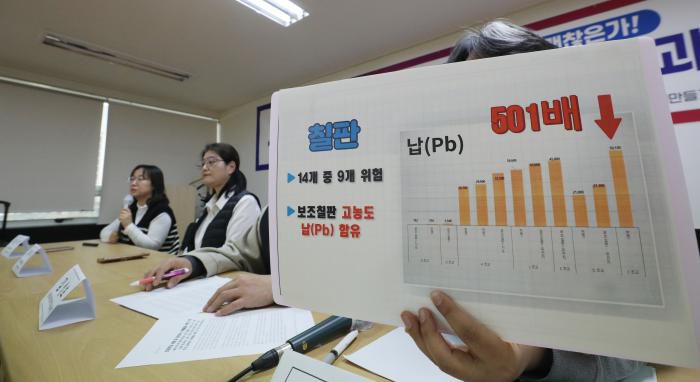
Officials from the National Teachers' Labor Union and the National Action for a Carcinogen-Free Society present the results of a survey on hazardous substances in elementary schools in Seoul at the National Teachers' Union Conference Center in Seodaemun-gu, Seoul, Friday. By Kwon Do-hyun |
A large amount of hazardous substances have been detected in elementary schools. There are calls for coming up with a separate management standard for hazardous substances in schools. On December 5, the Seoul branch of the Korean Teachers and Education Workers’ Union (KTU) and the People's Action for Making a Carcinogen-Free Society (People's Action) held a press conference at the KTU office in Seodaemun-gu, Seoul, and announced the results of a survey on hazardous substances in elementary school in Seoul.
The KTU and the People's Action inspected 81 items from 15 elementary schools in five districts of Seoul from October 11 to 18 and found that 31 items (38.3%) contained “dangerous” levels of hazardous substances and 35 items (43.2%) “cautionary” levels. Only 15 items (18.5%) were "safe." Dangerous" items refer to those that exceed the common safety standards of the Special Act on the Safety of Children's Products. These are items that contain high levels of lead or are made of polyvinyl chloride (PVC), a hazardous plastic. The most dangerous items were blackboards.
Of the 14 blackboards surveyed, nine (64.3%) had lead that goes beyond the permissible level of 100 PPM. Even a board had 50,100 PPM of lead, which is more than 501 times of the permissible level. Eight out of 14 (57.1%) shock absorbers installed at the gym also contained high levels of lead, and five out of 33 sofas in the library exceeded the permissible level. Choi In-ja, director of the Bio-monitoring Center at the Korea Research Institute of Work Environment and Health said, "Lead is a very harmful substance that is related to neurotoxicity and developmental toxicity of children, as well as attention deficit hyperactivity disorder and autism.”
Many of the items with the "cautionary” level were made of PVC. In particular, all shock absorbers at the gym were all made of PVC, which is often made of harmful phthalate plasticizers to soften products.
There is no specific standard for the management of hazardous materials in schools yet. The Special Act on the Safety of Children's Products applies only to the products used by children under the age of 13. Even if whiteboards or bulletin boards for offices exceed the standard for hazardous substances, it is difficult to regulate them. "We need to create management standards for all items used in schools, regardless of their purpose," said Park Soo-mi, secretary general of the People's Action for Making a Carcinogen-Free Society.
The KTU and the People's Action urged that the Seoul Metropolitan Office of Education should quickly implement follow-up measures to the "Ordinance on Prevention and Management of Hazardous Substances in School Education Environment," which was enacted in 2021. The ordinance requires school superintendents to conduct a survey on hazardous substances every three years and establish a management plan. School principals are required to report the results of hazardous substance inspections and all staff and members of schools should receive training on hazardous substances.
※This article has undergone review by a professional translator after being translated by an AI translation tool.
▶ 독립언론 경향신문을 응원하신다면 KHANUP!
▶ 뉴스 남들보다 깊게 보려면? 점선면을 구독하세요
©경향신문(www.khan.co.kr), 무단전재 및 재배포 금지
 이 기사의 카테고리는 언론사의 분류를 따릅니다.