
 |
H.E. Gourangalal Das, Ambassador of India to South Korea, speaks during an interview with AJP at the Aju News Room on Jan. 16, 2026. AJP Yoo Na-hyun |
"I think it is the Korean side's turn to visit. So we would like to have President Lee visit India at early mutual convenience," Ambassador Gourangalal Das told AJP in his first interview with a Korean media outlet.
Das said he was optimistic about an "early visit," and when asked whether the summit could take place within the year, replied, "hopefully sooner than that," while declining to provide further details.
Working-level discussions are already under way for what he described as "intense exchanges" between the two sides.
Das, who formally began his duties after presenting credentials in December, said preparations for outcome-oriented high-level meetings have effectively become his priority.
Key pillars under discussion include cooperation in shipbuilding, AI, semiconductors and energy, he said.
"Our prime minister has already met President Lee twice, but those were on the sidelines of multilateral events," Das noted. "We hope that very soon we will also have bilateral exchanges at high levels. There have already been several ministerial-level visits as well."
Shipbuilding at the top of India's industrial agenda
Das framed shipbuilding as the clearest area where India's policy push and Korea's industrial strengths intersect most directly.
On the economic front, he said New Delhi has placed shipbuilding near the top of its industrial priorities and recently launched what he described as "a very attractive incentive package."
"There is a huge demand for ships in India," Das said. "Korea brings a lot more value in terms of technology and competence, and it is a good, trusted partner."
India is backing that ambition with one of its most comprehensive industrial policy drives in decades. In its Union Budget announced last year the government unveiled a multi-layered shipbuilding strategy combining large-scale financing, cost support and cluster-based industrial development, aligned with its long-term road maps — Maritime India Vision 2030 and Amrit Kaal Vision 2047 — which aim to place India among the world’s top 10 shipbuilding nations by 2030 and the top five by 2047.
A cornerstone of the initiative is the Maritime Development Fund (MDF), planned with a corpus of Rs 25,000 crore (about $3 billion). The government will contribute 49 percent, with the remainder expected from ports and private investors. The fund is designed to provide long-term, lower-cost financing for shipbuilding and ship repair — a structural bottleneck that Indian yards have long cited.
Alongside this, New Delhi is revamping the Shipbuilding Financial Assistance Policy (SBFAP) to offset cost disadvantages faced by domestic yards, including mechanisms such as credit notes linked to shipbreaking at Indian facilities. Large vessels above a certain size are also being reclassified as infrastructure assets, unlocking easier access to financing and signaling a shift in how shipbuilding is positioned within India’s industrial ecosystem.
India is also accelerating the development of integrated shipbuilding clusters. Eight maritime clusters — five new and three expanded — are planned across coastal states including Andhra Pradesh, Gujarat and Odisha, combining shipyards with equipment manufacturing, logistics, training and ancillary services to raise productivity and meet global quality standards.
"We would like Korean companies to avail of these incentives and opportunities and come out in a big way," Das said.
He added that India is already in discussions with all three major Korean shipbuilders — HD Korea Shipbuilding & Offshore Engineering (HD KSOE), Hanwha Ocean and Samsung Heavy Industries (SHI) — ranging from vessel orders to the possibility of hosting a Korean shipyard in India.
Korean firms have begun laying groundwork. HD Hyundai Heavy Industries has signed memorandums of understanding with state-owned Cochin Shipyard for technology transfer and joint bidding, and with BEML for crane business cooperation, as it expands shipbuilding and offshore partnerships in India.
For Korean shipbuilders facing intensified price competition from China, India offers both an additional manufacturing base and access to a fast-growing market. Indian policymakers, for their part, see foreign partnerships and technology transfer as essential to lifting productivity and moving into higher-value segments.
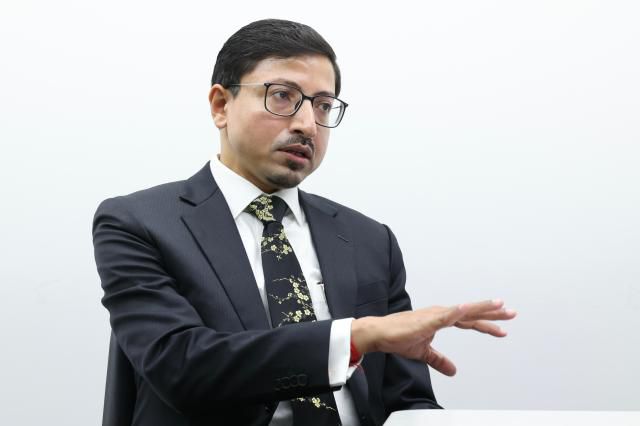 |
H.E. Gourangalal Das, Ambassador of India to South Korea, speaks during an interview with AJP at the Aju Newsroom on Jan. 16, 2026. AJP Yoo Na-hyun |
Semiconductors form another core pillar. While India's chip ecosystem is still "building," Das stressed that the industry requires "a huge number of ecosystem players," opening space not only for large Korean conglomerates but also for small and medium-sized firms.
"Even if not the big semiconductor giants, we see a lot of potential for small and medium-sized Korean players to help make that ecosystem grow," he said, calling semiconductors a high priority for the Indian government.
Das repeatedly emphasized the complementarity between the two economies.
"Compute capacity can be fully harnessed only if you have data and application potential," he said. "India has all of that. This is a good field for us to work together, and it could become the next big potential in India–Korea relations."
High-level exchanges, he noted, typically bring a mass-scale business delegation, and India hopes to use the momentum to broaden cooperation beyond a narrow set of industries.
"I do not want to limit my answer to just one or two industries," Das said. "Both our countries are focusing on AI and the different aspects of AI."
India is preparing to host the fourth AI Impact Summit next month, following earlier editions in Bletchley Park, Seoul and Paris. Das has argued publicly that India wants AI to deliver "economic growth through social inclusion, rather than social polarization."
Asked about Korea's interest in developing a domestic, OpenAI-style model and whether Indian talent could come to Korea, Das linked the issue to India’s sovereign AI initiative.
"India is a very diverse country," he said. "We want AI systems that reflect the essence of India, including its diversity, rather than making society very uniform and homogeneous."
India's model, he said, is being developed as multimodal, supporting audio and visual interfaces and multiple Indian languages, to reach not only elite engineers but also the roughly 300 million people who still lack easy access to digital tools.
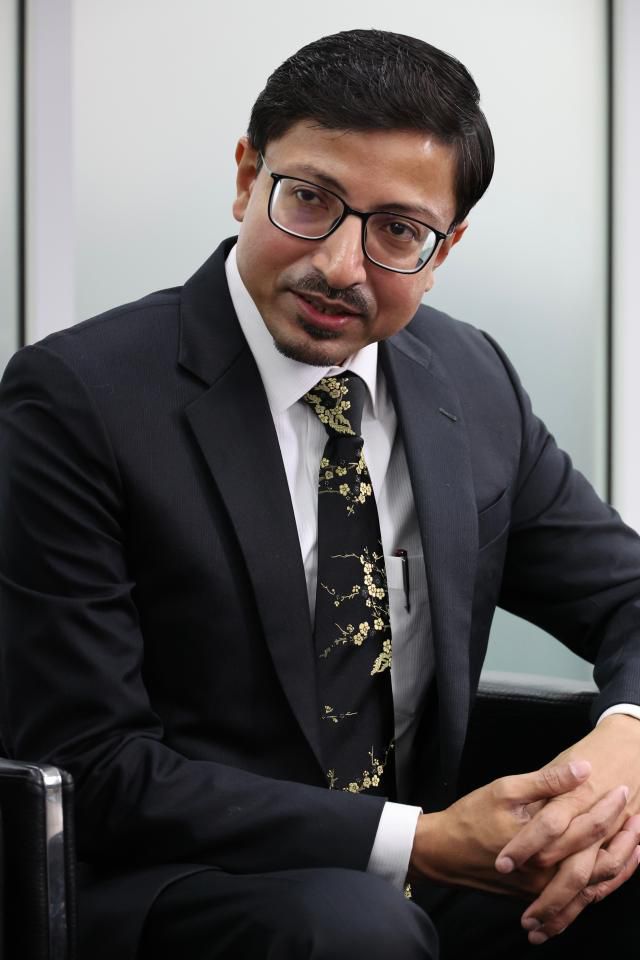 |
H.E. Gourangalal Das, Ambassador of India to South Korea, speaks during an interview with AJP at the Aju Newsroom on Jan. 16, 2026. AJP Yoo Na-hyun |
Das also pointed to K-content and entertainment as an area of untapped cooperation, noting that both countries bring complementary strengths.
On people-to-people ties, he highlighted what he called a "paradox" in Korea–India relations.
"Despite Korea being so good in so many areas, there are only about 3,000 Indian students in the country," he said. "Indian students and researchers want to experience life as global citizens."
Das said clearer post-study work pathways, broader access to skill-based employment, and stronger incentives for Korean-language learning would be critical to changing that equation.
Strategic autonomy, Act East — and why Korea matters
On geopolitics, Das stressed India's long-standing commitment to strategic autonomy, including amid fluctuations in U.S. politics.
"We don't want to create our foreign policy based on individuals," Das said when asked about frictions with Washington under the Trump administration. "We have, of course, very strong and resilient relations with the United States."
"I don't want you to be too focused on headline news," he added. "Irrespective of what might happen on a particular day or what gets people's attention, our relationship with the U.S. remains very strong and very comprehensive."
Das said India's foreign policy has consistently prioritized independence.
"We have always followed a very independent foreign policy which believes in maintaining our strategic autonomy," he said. "We have not formed any alliance with any country. We try to build good relations with all countries, and whenever differences arise, our approach has always been to deal with them bilaterally, without the intervention of others."
Positioning Korea firmly within India's regional strategy, Das underscored the importance of East Asia to India's long-term growth outlook.
"We look at the East Asia region as very critical to our own growth prospects," he said. "That is why for the past decade or so we have been promoting the Act East policy — of which Korea is very much at the center."
India and Korea, he noted, share interests across maritime security, defense, space cooperation and regional stability, and he described Korea as a core partner in translating India's Act East policy into concrete economic and industrial outcomes.
Against that backdrop, Das said the recent momentum in high-level exchanges would offer a chance to expand trade and investment — which he argued remain far below potential — and to push bilateral ties beyond a narrow set of projects into a more durable industrial and strategic partnership.
Kim Hee-su Reporter khs@ajupress.com
- Copyright ⓒ [아주경제 ajunews.com] 무단전재 배포금지 -
 이 기사의 카테고리는 언론사의 분류를 따릅니다.