
 |
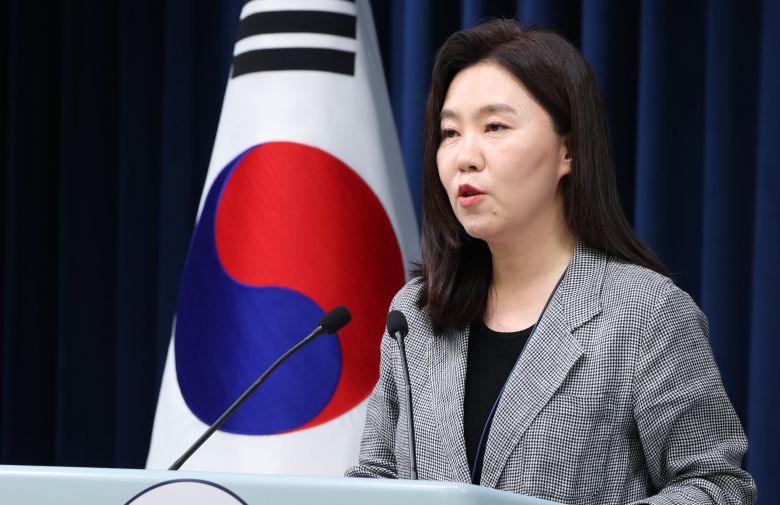
Presidential spokesperson Kang Yu-jung briefs on the senior secretaries’ meeting led by the chief of staff at the presidential office in Yongsan, Seoul on Aug. 4, 2025. /News1 |
In a recent U.S. media interview, Foreign Minister Cho Hyun said China is “becoming somewhat problematic for its neighbors,” adding, “We have observed what China has been doing in the South China Sea and the Yellow Sea.” He also expressed a desire to see China “abide by international law in regional affairs.” His remarks were sound and reasonable.
The Chinese Embassy in Seoul responded by claiming that China has “consistently and firmly upheld the UN system, the international law-based order, and the fundamental norms of international relations.” It also insisted that China maintains “good relations with all neighboring countries.” These claims contradict reality.
In 2001, South Korea and China agreed to designate a provisional zone in the West Sea due to an unresolved maritime boundary, allowing only fishing. Despite this, China deployed two large mobile structures under the label of “fish farms.” It also built fixed steel structures with helipads, effectively planting artificial islands. When a South Korean research vessel approached, armed Chinese civilian boats blocked it. In May, China declared a no-sail zone in part of the West Sea and carried out military drills using an aircraft carrier. It even raised objections to the Ieodo ocean research base, which was established before the agreement. China is trying to claim the West Sea as its internal waters. These are not simply “somewhat problematic” actions, as Cho put it, but clear attempts to infringe on South Korean sovereignty.
China’s actions in the South China Sea go beyond what can be described as mere aggression. Beijing claims nearly the entire sea, which is larger than the Mediterranean and located far from its own shores, as its territorial waters. This includes areas just off the coasts of other nations. It outright ignores the ruling of an international tribunal that invalidated these claims. China has poured cement over reefs to create artificial islands and has turned them into military bases. Its use of force against the Philippines near their own shores is a blatant act of illegal violence. These are open violations of the UN framework and international law.
What is baffling is the presidential office’s response. Despite there being nothing wrong with Minister Cho’s remarks, it issued a statement seemingly aimed at clarifying them to China. The statement described his comments as a reaffirmation of ongoing efforts to foster a cooperative relationship despite differences. It made no mention of China’s illegal structures or its military presence in the West Sea. Even if the goal is to arrange a visit by Chinese President Xi Jinping, sovereignty is not a matter for negotiation.
The Trump administration already suspects President Lee Jae-myung of being pro-China. With the Korea-U.S. summit approaching, if the presidential office further fuels such doubts, what good will it do for the government or national interest?
[The Chosunilbo]
- Copyrights ⓒ 조선일보 & chosun.com, 무단 전재 및 재배포 금지 -
 이 기사의 카테고리는 언론사의 분류를 따릅니다.