 |
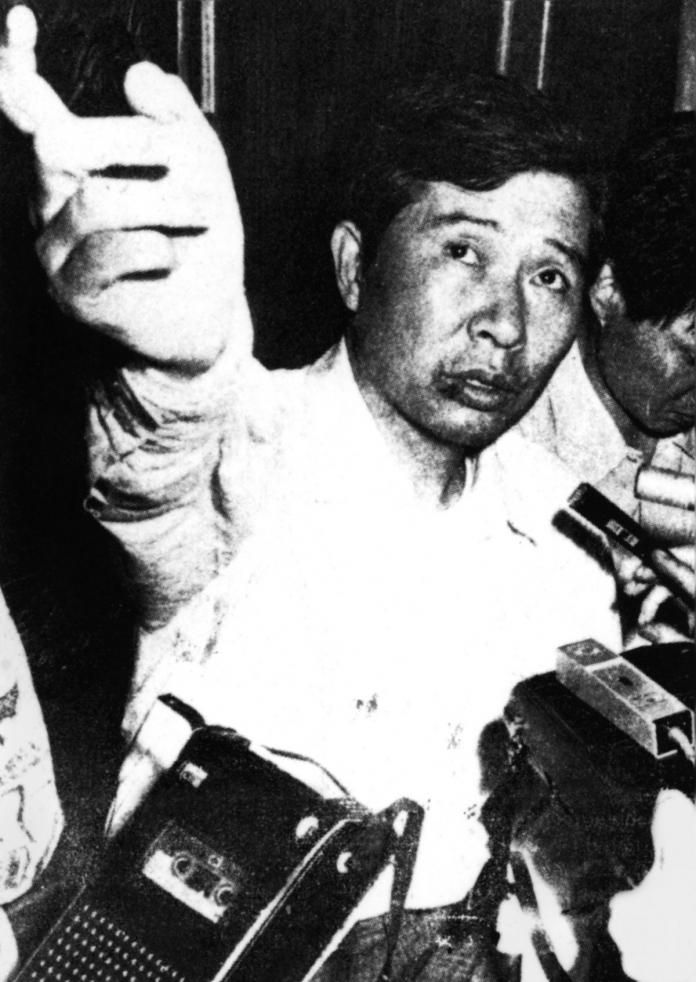
Former President Kim Dae-jung speaks at a press conference shortly after his return from abduction in 1973. / Courtesy of Hangilsa |
Kim Dae-jung, who would later become president, was in Japan on October 17, 1972, when the Park Chung-hee regime declared martial law. That year, he had been traveling frequently to Japan for treatment related to injuries from a car accident and to meet with Japanese politicians. On the day martial law was declared, he had just returned from a meeting with Kenzo Kono, then president of Japan’s House of Councillors. Kim informed his wife, Lee Hee-ho, that he would not be able to return to Korea, and the next day, he began what would become a long exile.
In fact, Kim had predicted the situation in his diary entry dated August 26, 1972, prior to the martial law declaration: “There will be no elections in 1975.” His prediction proved correct. During his presidential campaign in 1971, he had warned repeatedly that if regime change failed, there would be no future elections.
“I write this diary with a heart torn apart, for as of today, even the shell of democracy in our homeland has disappeared. … I have come to believe that Park Chung-hee’s talk of inter-Korean unification is merely a false pretext, and his real goal is indefinite dictatorship.” (October 17, 1972)
Following the martial law declaration, the National Assembly was dissolved and the constitution was suspended. Kim called it “a thunderous outrage, an unforgivable, anti-democratic act.” He had to choose between returning to Korea or remaining in exile. Returning meant almost certain arrest and political silence under the new Yushin regime. He instead decided to wage an anti-Yushin struggle from abroad, traveling between Japan and the U.S.
The recently published Kim Dae-jung’s “Exile Diary,” published by Hangilsa, contains 223 handwritten diary entries written by Kim between August 3, 1972, and May 11, 1973. Last summer, while sorting through personal belongings, Kim Hong-gul, head of the Kim Dae-jung and Lee Hee-ho Foundation and son of the late president, discovered six small notebooks in a shopping bag at the family’s home in Donggyo-dong, Seoul. The diaries had never been publicly mentioned by Kim during his lifetime. Written in old Korean words and often using Japanese-style Chinese characters, the texts required a year-long collaborative effort among experts to accurately transcribe and interpret.
At a press briefing held on July 22 at the Kim Dae-jung Library in Mapo-gu, Seoul, Kim Hong-gul said, “I found a bunch of documents and diaries tucked inside a shopping bag while going through personal effects. Since there was no reference to them, they almost ended up in the trash. But luckily, they were discovered and could be published as a book.”
The original title written in the diary was “Longing for Home: A Diary,” but the editors ultimately changed it to “Exile Diary” in recognition of its historical value. Park Myung-lim, director of the Kim Dae-jung Library at Yonsei University, explained, “While these entries express Kim’s longing for his homeland and family as an individual, they also serve as a public record of political exile during martial law. After much deliberation, we chose the word ‘exile’ to reflect its broader meaning.” Publisher Kim Eon-ho said, “This work is comparable to ‘Nanjung Ilgi: War Diary of Admiral Yi Sun-sin,’ offering a vivid record of an era.”
The book provides a vivid account of the tense domestic and international climate of the time. During his stay in Japan, the U.S., and then Japan again, Kim documented in detail whom he met and what he did. He reached out to major U.S. media outlets like The Washington Post and The New York Times to publicize his views and met with academics such as Harvard’s Edwin Reischauer to highlight the crisis of democracy in Korea. He also built alliances with politicians, including Senator Edward Kennedy, the younger brother of former U.S. President John F. Kennedy, to raise international opposition to the Yushin regime.
“Senator Kennedy told me he had read an article on Korea in The New Yorker, and that I should feel free to ask him for anything. He said he was more concerned about me personally than about Korea itself, and insisted I stay in touch even if I returned home. His kindness was overwhelming.” (December 13, 1972)
Park Myung-lim remarked, “One could say that Kim functioned as a de facto alternative government, representing freedom, human rights, and democracy.”
The diary entries also contain the deep emotional turmoil of a man who left behind his wife and three sons under a mountain of debt, the anguish of a politician waging an uncertain, prolonged struggle, news of former comrades wavering under the regime’s pressure and temptations, and frustration with elites who turned a blind eye to domestic suffering in favor of personal safety.
“The value of life doesn’t lie in how high one rises, but in how rightly and earnestly one lives. Yet we forget this eternal truth and obsess over money and power, losing even ourselves in the process. The most noble life is one that stands unashamed before God and one’s conscience, and is lived in service to the people and all humankind." (August 14, 1972)
“This is not a forced claim. Based on scientific grounds and the inevitable course of history, I am certain the Park Chung-hee regime will fall. I will prepare for the day of my victory.” (January 1, 1973)
“It pains me to think of my family and comrades in prison. What hurts most is that I can do nothing for them.” (January 19, 1973)
“Lord, grant democracy to our nation. Lord, bring comfort to our suffering people and comrades. Lord, protect my family. Lord, awaken in all citizens the realization that their rights must be won through sacrifice.” (March 1, 1973)
At the press briefing, Kim Hong-gul also drew a pointed comparison between past and present. “Just as the Park Chung-hee regime launched a self-serving coup and kidnapped opposition leaders to consolidate dictatorship, the Yoon Suk-yeol administration blamed the people for its election defeat, spread conspiracy theories about election fraud, and even declared martial law. In such a moment, the emergence of a historic record like the ‘Exile Diary’ is all the more welcome.” The book was curated by the Kim Dae-jung Library at Yonsei University and runs 444 pages.
※This article was translated by an AI tool and edited by a professional translator.
▶ 매일 라이브 경향티비, 재밌고 효과빠른 시사 소화제!
▶ 주 3일 10분 뉴스 완전 정복! 내 메일함에 점선면 구독
©경향신문(www.khan.co.kr), 무단전재 및 재배포 금지
 이 기사의 카테고리는 언론사의 분류를 따릅니다.