
 |
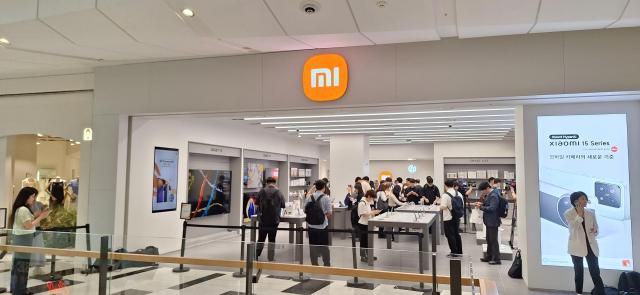
Xiaomi's first offline store, the Mi Store, offering a sneak before its official opening, June 25. Economic Daily Jo Seong-jun |
Along with the flagship smartphone, the Beijing-based company also unveiled its new foldable phone on Thursday, "the Mix Flip 2," as it seeks to penetrate Samsung's stronghold in the premium smartphone lineup held tight by the traditional bar-shaped Galaxy S25 series and foldable Galaxy Z Fold 6.
"Through the Mi Store opening, we hope domestic consumers can intuitively experience Xiaomi's technology and brand," said Johnny Woo, chief of Xiaomi Korea, adding that the company plans to expand its ecosystem from smartphones to smart home products nationwide.
Beyond flagship devices, Xiaomi is also targeting the budget market with its Poco M7 Pro 5G smartphone priced in the 200,000 won (US$147.4) range, expanding its assault across multiple price points.
The strategy highlights a stark contrast between Xiaomi's global prowess and its struggle in South Korea. Market research firm Canalys ranked Xiaomi third globally with a 14 percent share in the first quarter, trailing Samsung's 20 percent and Apple's 19 percent.
In wearables, Xiaomi commands the top spot with 19 percent of the global market, demonstrating its technological capabilities beyond smartphones.
However, the company's performance in South Korea tells a different story. Industry data shows Xiaomi held less than 1 percent of the local smartphone market in the first quarter of 2025, with daily sales reportedly failing to reach even a single unit from time to time.
In contrast, Samsung held 60 percent of the South Korean smartphone market in the fourth quarter of 2024, Apple following with 39 percent.
Even its executive Johnny Woo brings expertise in global production strategy and supply chain optimization rather than marketing, having built his career primarily in emerging markets including India, Indonesia, Turkey, Pakistan and Egypt.
Meanwhile, analysts cite security concerns over Chinese products and low brand loyalty as major obstacles, while the failure of foreign brands, including Nokia, HTC, Motorola and BlackBerry serves as a cautionary tale.
Kim Dong-young Business Reporter davekim0807@ajupress.com
- Copyright ⓒ [아주경제 ajunews.com] 무단전재 배포금지 -
 이 기사의 카테고리는 언론사의 분류를 따릅니다.