
 |
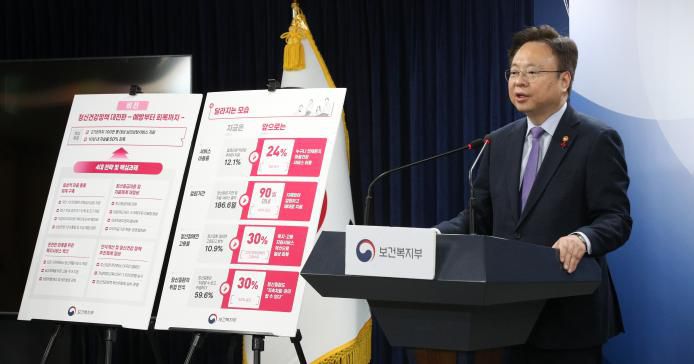
Minister of Health and Welfare Cho Kyu-hong holds a briefing on innovative measures for mental health at the Government Complex in Jongno-gu, Seoul, on Dec. 5. 2023.12.05 Kwon Do-hyun Reporter |
The government has announced that it will place mental health issues on the national agenda by establishing a pan-governmental mental health policy innovation committee. The goal is to help young people conduct mental health checkups every two years and provide psychological counseling services to one million people by 2027 for early detection and intervention.
On December 5, the government announced the countermeasures to address mental health problems in the country during a meeting on the related policy, which was presided over by President Yoon Suk-yeol, at Cheong Wa Dae.
South Korea's suicide rate was 25.2 per 100,000 people in 2022, the highest among member countries of the Organization for Economic Cooperation and Development (OECD). Mental health problems have worsened during the coronavirus pandemic due to isolation and economic difficulties. According to the Ministry of Health and Welfare, the number of patients treated for mental illness, including dementia, has been increasing since 2015 -- 2.89 million in 2015, 3.21 million in 2017, 3.68 million in 2019, and 4.11 million in 2021.
The government plans to establish a presidential committee by March next year to collect opinions from young people, related ministries, and medical and social welfare circles to come up with measures for the long-term and complicated mental health issues.
The committee will focus on establishing and improving an early detection and intervention system in addition to the existing policies, which mainly focus on treatment and care. Medical institutions will provide professional psychological counseling to those with emotional and psychological difficulties. The service will be provided to 80,000 high-risk patients next year, which will be increased to 500,000 by 2027.
Young people can have a mental health check-up every two years. The government will increase its support for professional counseling services for workers and raise the number of occupational trauma centers to a total of 23 by adding nine new centers next year.
The treatment system for seriously ill mental health patients will be strengthened. The Joint Response Centers by mental health professionals and the police, which are operating 24 hours a day in Seoul and Gyeonggi Province, will be expanded to 17 cities and provinces nationwide. In addition, the compensation system for medical institutions will also be strengthened. The institutions will receive increased fees for intensive management of isolation wards and protection of high-risk patients. The system for supporting outpatients’ treatment, which has not been well applied in the field, will be activated again. The information of patients who have engaged in self-harm will be transferred from medical institutions to local governments without their consent if necessary and the local governments will closely monitor the patients.
In the wake of the stabbing rampage near Seohyeon Station in Bundang, Gyeonggi Province, last August, the government has been operating a task force to improve the involuntary hospitalization system for the mentally ill. The 'judicial hospitalization system' will be discussed at this stage.
The committee will also support people with serious mental illnesses to enjoy their lives independently in the local communities and establish minimum standards for the establishment of mental rehabilitation facilities in each city and district. Next year, all residents in mental care facilities will be surveyed and relocated to facilities for the elderly, disabled, and mentally ill. As a solution for economic independence, it will include people with severe mental illness in the vulnerable group under the Social Enterprise Promotion Act and create jobs that are specialized for people with mental disabilities.
The government will strengthen housing support, including a specialized buy-to-let housing system for people with mental illness who can manage their lives on their own.
It will also check whether there is discrimination for mental health patients to take out insurance and conduct research for developing insurance products for them, which can be seen as the result of reflecting the continuous demands of the patients.
In order to expand access to psychological counseling services, it is also necessary to increase the budget, the number of professional counselors, and improve their working conditions. The Ministry of Health and Welfare plans to increase the number of professional counselors from 194,000 this year to 228,000 by 2027 and to improve their treatment by raising salaries.
However, some say that some policies may be less effective due to social bias.
In order to prevent the government's plans from becoming “declaratory measures," it is important for the government to gather the momentum to implement the policies by securing budgets and through communication.
※This article has undergone review by a professional translator after being translated by an AI translation tool.
▶ 독립언론 경향신문을 응원하신다면 KHANUP!
▶ 뉴스 남들보다 깊게 보려면? 점선면을 구독하세요
©경향신문(www.khan.co.kr), 무단전재 및 재배포 금지
 이 기사의 카테고리는 언론사의 분류를 따릅니다.