
 |
The cut in corporate tax rates and other incentives for corporate and investment activities in the first tax code revision pursued by the South Korean government under Yoon Suk-yeol presidency is expected to bolster the bottom line of big Korean Inc. by 3 to 4 percent as well as dividend payout.
According to brokerages on Monday, the tax reform outline pending legislative review and approval will have positive influence on the local stock market from the cut in corporate taxes and securities trade, and adjustments in levies on dividend income from overseas.
The government proposes to lower the maximum rate of corporate income tax to 22 percent from 25 percent starting next year while simplifying the corporate tax rate brackets to two from four to bring about cuts to wider companies in the mid to lower level.
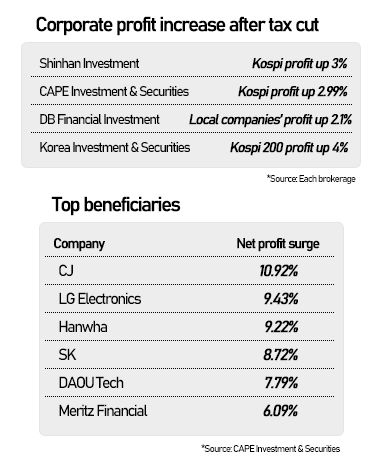
“A 3 percentage point cut in tax rate is estimated to lead to a 3 percent increase in profit for Kospi companies,” said Noh Dong-gil, an analyst at Shinhan Securities. “About six Kosdaq companies will fall under the category, but the benefit on small and mid-size stocks will be limited.”
Kospi companies’ overall cost on corporate taxes will be reduced by 9.36 percent, saving them about 2.26 percentage in average valid tax rate, according to Sohn Joo-sup, a researcher at CAPE Investment & Securities. The tax saving could translate into about 2.99 percent gain in the bottom line for Kospi members, he added.
The tax cut would mostly benefit IT, home appliance, trade, chips, energy, and banking sectors.
Potential gainers Sohn from CAPE Investment & Securities named were CJ (net profit estimated to gain 10.92 percent), LG Electronics (9.43 percent), Hanwha (9.22 percent), SK (8.72 percent), DAOU Tech (7.79 percent), Meritz Financial (6.09 percent), GS (5.25 percent), SK innovation (5.23 percent), Hyundai Motor (4.65 percent), and CJ CheilJedang (4.49 percent).
Chip, banking, and automotive industries can also save about 4.7 trillion won ($3.6 billion) from tax cut, translating into gains in net profit by 2.1 percent in 2023, said Seol Tae-hyun from DB Financial Investment.
The net profit of Kospi 200 companies can increase by 4 percent, according to Yeom Dong-chan, an analyst at Korea Investment & Securities.
The adjustment in double taxation on dividends can lead to higher dividend payments by local companies.
The tax reform outline simplifies overall non-inclusive rate of income dividend system. Companies will pay less tax for dividend income from subsidiaries at home and abroad.
The proposal to put off the employment of capital gain tax on financial investment to 2025 also could help market sentiment.
The government tax bill to be submitted Sept. 2 faces uphill in the legislative dominated by liberal Democratic Party which opposes to cuts for individual and corporate riches.
[ⓒ Maeil Business Newspaper & mk.co.kr, All rights reserved]
 이 기사의 카테고리는 언론사의 분류를 따릅니다.