
 |
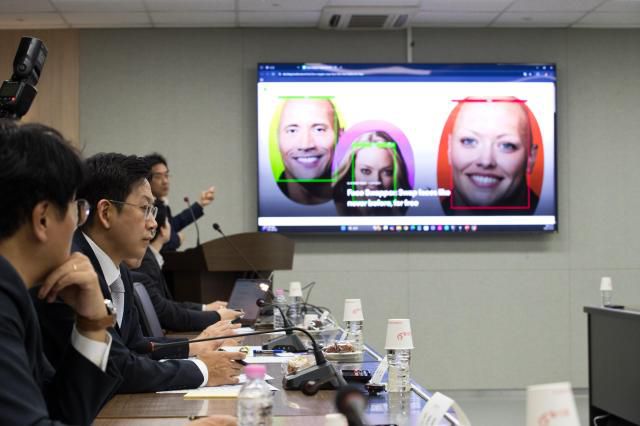
Minister of Science and ICT Bae Kyung-hoon visits the AI Safety Institute/ Courtesy of the Ministry of Science and ICT |
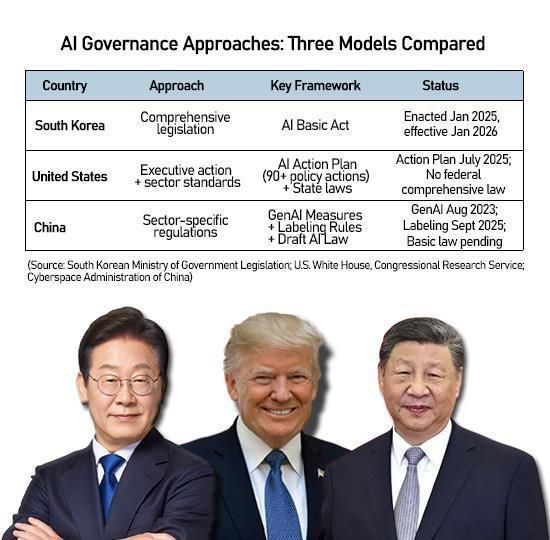
The Basic Act on the Development of Artificial Intelligence and the Establishment of a Foundation for Trustworthiness, or the AI Basic Act, which took effect a year after its promulgation, governs everything from deepfake labeling to high-impact AI oversight. South Korea is the second jurisdiction after the European Union to enact a comprehensive AI statute, but its approach diverges sharply from Brussels.
South Korea's AI Basic Act takes a hybrid approach—more autonomous than the EU but stricter than the U.S. federal government. While all three have mandated identification watermarks for AI-generated content, the U.S. runs on dual tracks—the federal government emphasizing self-regulation while state governments pursuing detailed regulations. On the contrary, the EU categorized AI into four risk levels and banned high-threat AI usages, including those applying to social scoring systems and real-time biometric surveillance in public spaces.
The Ministry of Science and ICT said the legislation fills regulatory gaps left by existing telecommunications and information network laws, which were not designed to address AI-generated content or algorithmic discrimination. The ministry pledged a "soft landing" for businesses by deferring its investigative powers and penalty enforcement for at least one year.
Under the law, operators of high-impact AI systems in sectors such as healthcare, energy, hiring and loan assessments must implement human oversight and safety measures. The government said only fully autonomous vehicles at Level 4 or above currently meet the high-impact threshold, though industry observers expect the category to expand rapidly as AI capabilities advance.
The law also enshrines a right to explanation, requiring AI operators to provide clear and meaningful information about the criteria and principles behind algorithmic decisions. Industry groups have characterized the provision as largely symbolic, noting that only a handful of companies worldwide possess the technical capability to interpret complex AI reasoning processes.
 |
Graphics by AJP Song Ji-yoon |
The creative sector has mounted broader resistance. Sixteen organizations representing writers, artists and other content creators issued a joint statement on Jan. 13 demanding the government withdraw and overhaul its national AI action plan.
"The government's AI action plan is an attempt to fundamentally violate copyright as private property rights, and amounts to a declaration that it will abandon the sustainability of Korea's cultural industries," the groups said. They added that the government is "taking the lead in removing legal barriers so AI companies can use copyrighted works without permission and at virtually no cost."
The gaming industry has raised similar complaints, citing ambiguity over how AI disclosure rules apply to interactive entertainment classified as artistic expression. Regulators have said games may use labeling methods that do not disrupt the viewing experience, but have not specified concrete standards.
Kim Dong-young Business Reporter davekim0807@ajupress.com
- Copyright ⓒ [아주경제 ajunews.com] 무단전재 배포금지 -
 이 기사의 카테고리는 언론사의 분류를 따릅니다.