
 |
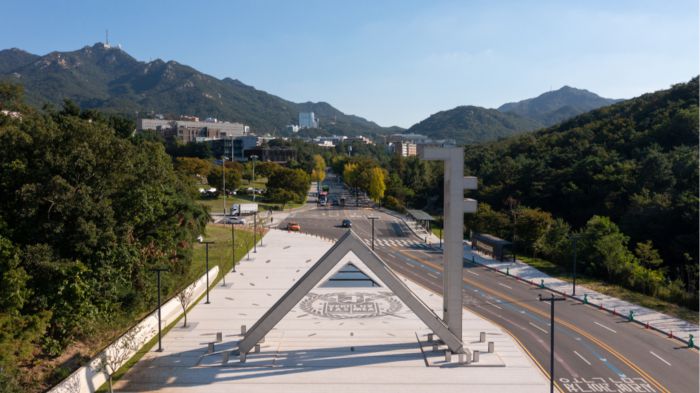
Seoul National University |
The fierce competition in artificial intelligence (AI) is spreading from industry into university campuses in South Korea, with leading institutions rushing to secure talent that will determine leadership in future technologies such as semiconductors and robotics.
Maeil Business has learned on Thursday that Seoul National University’s (SNU’s) newly established Graduate School of AI is expected to integrate existing AI-related master’s and doctoral programs – such as Interdisciplinary Program in Artificial Intelligence and the Graduate School of Data Science – into single graduate school, while also creating new interdisciplinary tracks.
Once established, SNU plans to pursue three pillars simultaneously – talent cultivation, new industry development, and advanced research.
As internal review by SNU’s deliberative bodies has not yet begun, however, it is expected to take more than six months before AI graduate school becomes operational.
Unlike the graduate program, the establishment of an AI-related undergraduate program has not yet been formally discussed.
The urgency in strengthening AI competitiveness reflects its ambition to become Korea’s leading university in the AI field.
Currently, the Korea Advanced Institute of Science and Technology (KAIST) is widely regarded as the top domestic university for AI research.
In the Times Higher Education’s World University Rankings by Subject 2025: Computer Science, KAIST placed 39th globally, the highest among Korean universities, while Seoul National University ranked 49th. No other Korean universities made it into the top 50.
KAIST has also announced plans to establish a standalone AI college next year.
Unlike the United States, where big tech companies lead AI research, universities play a central role in Korea’s AI ecosystem, elevating academic investment in AI to a strategic national priority.
Other universities are following suit.
Soongsil University plans to launch a specialized AI graduate school next year alongside new departments focused on AI convergence security and AI bioengineering.
Yonsei University and Sungkyunkwan University have opened AI semiconductor innovation institutes in partnership with the Ministry of Science and ICT.
The competition for faculty has also intensified.
Sungkyunkwan University recently hired Ahn Min-sung, a former staff mechanical engineer at Tesla Inc., to lead its newly established robotics department, offering unusually generous terms to attract expertise in so-called physical AI.
Yonsei University recruited Lee Bong-shin, a former Microsoft AI researcher, as a professor in advanced computing, last year.
Still, some academics caution that the rapid expansion of AI programs could prove more cosmetic than transformative.
“Redrawing organizational charts is less important than building an environment where talented students can pursue genuinely original research,” said a professor at KAIST who asked to be unnamed.
He warned that without deeper institutional support, newly created programs may struggle to deliver on their promise.
Others caution against an AI-driven “ranking race,” where universities concentrate resources on areas that promise quick results and funding.
“Since research ultimately depends on outcomes and funding, most AI-related research is popular right now,” said a professor at Seoul National University’s College of Natural Sciences who asked for anonymity. “But before long, there will be a clear divide between fields that are easy to fund and produce results and those that are not. Universities and the government should start systematically restructuring research frameworks now to prepare for that phase.”
 이 기사의 카테고리는 언론사의 분류를 따릅니다.