
This article was released as Pharm Edaily Premium Content on December 17, 2025, at 8:10 AM.
[NA Eun-kyung, Edaily Reporter] South Korea’s stock market was swept by a hair loss theme on the 16th, with shares of pharmaceutical companies directly or indirectly linked to hair loss treatments surging to their daily price limits.
Medipost also drew attention after successfully closing a 205 billion won funding round, fueling expectations that its U.S. Phase 3 clinical trial would proceed smoothly. The company’s shares rose by double digits in the over the counter market. Acryl which debuted on the KOSDAQ the same day, climbed 244 percent from its initial public offering price of 19,500 won, marking a strong market debut.
In contrast, Oscotec retreated sharply after a brief rally despite news of a major deal with Sanofi as tensions with minority shareholders continued to weigh on investor sentiment.
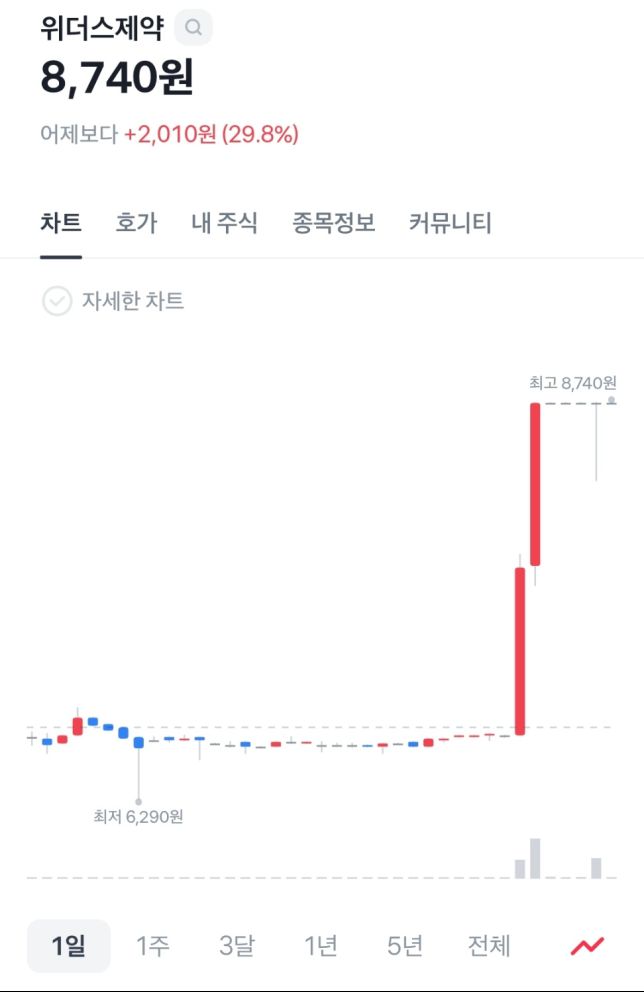 |
Withuspharm’s share price began rebounding at around 2:30 p.m. on the 16th and closed the session at its daily upper limit. (Source: Toss Securities) |
“Hair Loss Is a Matter of Survival”; Related Shares Surge
The rally in hair loss related stocks was sparked by remarks from President Lee Jae-myung. During a Ministry of Health and Welfare briefing in the afternoon, Lee described hair loss as “a matter of survival” and urged Health Minister Jung Eun kyung to review the possibility of including hair loss treatments in national health insurance coverage, noting that coverage could help lower drug prices.
Following media reports at around 2:20 p.m., shares of hair loss drug makers began to soar. Among the biggest gainers were Withuspharm, up 29.8 percent, JW shinyak up 26.1 percent and Hyundai Pharm, up 11.1 percent.
JW shinyak and Hyundai Pharm were seen as direct beneficiaries as both companies already market multiple hair loss treatments. In South Korea, only three active ingredients are approved for hair loss drugs finasteride, dutasteride and minoxidil.
JW shinyak sells Dutamoa which contains dutasteride Monad, based on finasteride; and Mydil, which uses minoxidil. Last year, the company also began distributing and selling Ducray Neoptide Expert a hair care cosmetic product under an exclusive domestic supply agreement with France’s Pierre Fabre.
Hyundai Pharm markets Damodart a dutasteride-based product Minofesia which contains finasteride and Mynoxil a minoxidil formulation. The company has a strong presence as a pioneer in the topical minoxidil market.
Withuspharm’s rally was largely attributed to expectations surrounding IVL3001, though analysts note that the company is still some distance away from monetization compared with JW New Drug and Hyundai Pharm which already generate revenue from marketed products.
IVL3001 is a finasteride-based hair loss treatment being co developed by Inventage Lab and Daewoong Pharmaceutical. The product is designed as a once monthly injectable formulation. Withers Pharmaceutical is a contract manufacturing partner of Inventage Lab and is set to receive royalties in the double-digit percentage range on shipments once the product is launched.
Inventage Lab submitted an investigational new drug application for a Phase 2 trial of IVL3001 to Australia’s Therapeutic Goods Administration on March 10.
The domestic market for hair loss treatments was estimated at 115 billion won in 2021. Including health supplements and food products, the broader hair loss related market in South Korea is estimated at 4 trillion to 5 trillion won annually.
Medipost Shares Rise on Funding Success
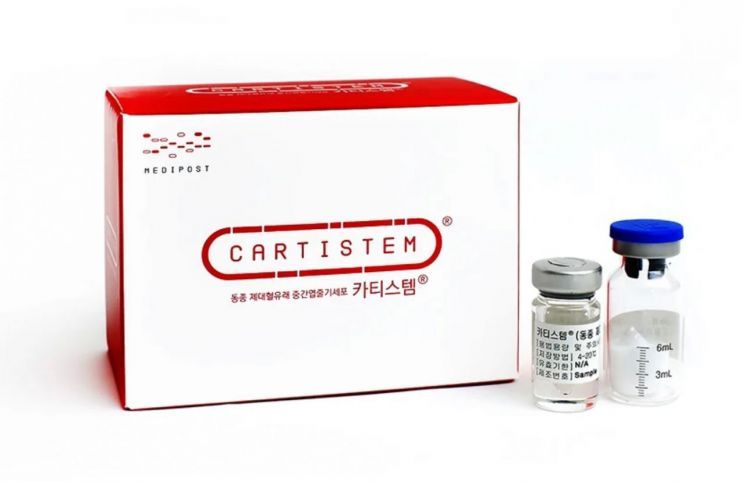 |
Medipost’s 'Cartistem' for knee osteoarthritis (Source: Medipost) |
Medipost’s shares climbed 13.8 percent in the Nextrade after-market, defying the usual negative reaction to news of convertible bond issuance.
The rebound was attributed to strong participation from major shareholders Skylake Equity Partners and Crescendo Equity Partners, as well as new domestic investors in the bond offering. Investor optimism was also supported by expectations that global commercialization of the company’s flagship product, Cartistem, is nearing.
Medipost recently completed a Phase 3 clinical trial of Cartistem for knee osteoarthritis in Japan and is preparing to launch a Phase 3 trial in the United States next year. The 205 billion won funding round disclosed this week is intended to finance the U.S. trial. While earlier market estimates had put the fundraising size at around 250 billion won, the final amount came in slightly lower.
The company completed dosing in 130 patients for the Japanese Phase 3 trial in November last year and is currently conducting follow up observations. The final patient completed a one year follow up last month. Medipost plans to compile the data and disclose the clinical study report for the Japanese trial in the first half of next year.
A company official said Medipost aims to apply for marketing approval with Japan’s Pharmaceuticals and Medical Devices Agency in the second half of next year and begin dosing the first patient in the U.S. Phase 3 trial in the first half.
Cartistem, approved by South Korea’s Ministry of Food and Drug Safety in 2012, is the country’s first stem cell therapy to be used in clinical practice for more than a decade. Last year, Cartistem generated 20.2 billion won in sales accounting for 27 percent of Medipost’s total revenue.
The company is currently conducting a real world evidence study involving more than 500 domestic patients to quantitatively demonstrate the long-term outcomes of Cartistem treatment.
Oscotec Falls Despite 1.5 Trillion Won Deal
Oscotec ended the day with a double digit decline despite announcing a major licensing deal with a global pharmaceutical company.
The company’s shares closed down 11.2 percent at 54,400 won. Ahead of the market open, Oscotec disclosed a major agreement with Sanofi sending the stock up 29.8 percent to 79,600 won in Nextrade’s pre-market session but the rally quickly faded. Ongoing disputes with minority shareholders were seen as a key drag on the stock.
Oscotec licensed out ADEL-Y01, an Alzheimer’s disease drug candidate co-developed with unlisted biotech firm ADEL, to Sanofi. The deal is worth up to $1.04 billion, or about 1.53 trillion won, including an upfront payment of $80 million, or roughly 118 billion won. The upfront portion accounts for 7.7 percent of the total contract value, a relatively high ratio compared with the typical 3 to 5 percent seen in licensing deals between Korean companies and global pharmaceutical firms.
ADEL-Y01 was developed by ADEL, founded by Professor Yoon Seung-yong of Asan Medical Center in Seoul. Oscotec entered a joint research and development agreement with ADEL in October 2020 and has since overseen manufacturing as well as preclinical and clinical development.
PharmEdaily reported that profits from ADEL-Y01 will be split 53 percent to ADEL and 47 percent to Oscotec under the agreement. As a result, Oscotec will receive about 55.3 billion won from the upfront payment alone. The company posted revenue of 34 billion won last year, making the deal a significant boost after recent attempts to raise external funding fell through.
Oscotec Chief Executive Officer Yoon Tae-young said the licensing agreement transfers full development rights for ADEL-Y01 to Sanofi, adding that no additional research and development costs will be incurred by Oscotec or ADEL going forward.
 이 기사의 카테고리는 언론사의 분류를 따릅니다.