
 |
(Yonhap) |
South Korea’s current account surplus extended for the 30th month in October, although the surplus narrowed sharply due to fewer working days, data showed on Friday.
According to data released by the Bank of Korea, the country’s current account surplus stood at $6.81 billion in October, extending the positive streak for the 30th consecutive month. The size of the surplus, however, fell by $6.66 billion from September and by $2.59 billion compared with the same month last year.
The cumulative current account surplus for the January-October period reached $89.58 billion, about 17 percent higher than the same period a year ago, data showed.
The BOK said the surplus streak is now the longest since the 2000s, following 83 consecutive months of surplus after March 2019.
“The cumulative surplus from January to October this year is the largest ever recorded, and the annual trend remains favorable,” said Song Jae-chang, head of financial statistics department at the BOK.
Song added that although the October surplus shrank from September, the surplus is expected to rebound to more than $10 billion starting in November as the holiday effect disappears and chip exports drive strong trade surpluses.
The BOK recently projected the annual current account surplus for this year to reach $115 billion, the highest on record.
The goods account recorded a surplus of $7.82 billion, about half the $14.24 billion seen in September and smaller than the $8.07 billion a year earlier.
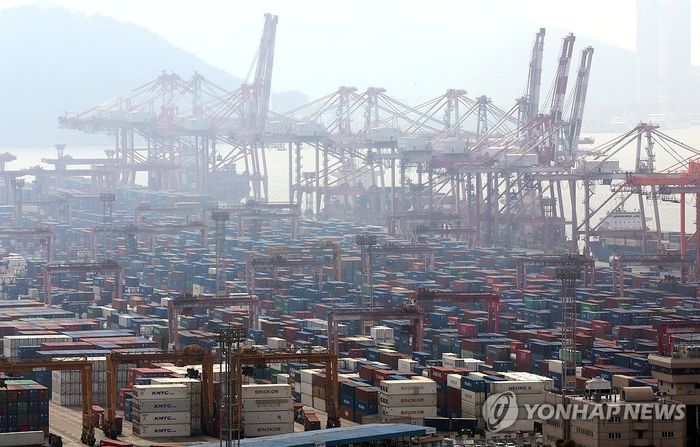
Exports totaled $55.9 billion in October, down 4.7 percent from a year earlier and down 17 percent from a month ago.
Semiconductor-led information and technology (IT) exports continued to grow, but non-IT shipments fell because one-off ship deliveries were adjusted and working days declined, which pushed total exports back into year-on-year contraction for the first time in two months.
Customs data showed semiconductors rising 25.2 percent and computer peripherals 3.5 percent. Wireless communication devices fell 8.7 percent, steel products 14.1 percent, chemical products 13.1 percent, passenger cars 12.6 percent, and machinery and precision instruments 12.3 percent.
By region, exports to the U.S. declined 16.1 percent, Japan 7.7 percent, China 5.2 percent, and the EU 2 percent. Southeast Asia recorded growth of 11.1 percent.
Imports reached $48.06 billion, down 5 percent from $50.57 billion a year earlier. Lower energy prices pushed raw material imports down 6.4 percent, with gas falling 37.2 percent, coal 18.6 percent, petroleum products 13.1 percent, and chemical products 7.6 percent. Crude oil imports rose 6.8 percent.
Capital goods imports declined 0.6 percent in October as ICT devices fell 5.6 percent and semiconductors 1.6 percent. Consumer goods imports rose 9.9 percent, driven by an 834.4 percent surge in gold imports.
The services account posted a $3.75 billion deficit, widening from the $3.32 billion deficit in September and the $1.93 billion deficit a year earlier. The travel account deficit increased to $1.36 billion from $910 million in September as outbound travel rose during the long Chuseok holiday.
The primary income account recorded a $2.94 billion surplus, similar to the $2.96 billion in September. Dividend income posted a $2.29 billion surplus.
Net assets in financial account increased by $6.81 billion in October.
Direct investment of Koreans overseas added $1.88 billion while that of foreigners in Korea $150 million.
In securities, Koreans’ investment gained $17.3 billion and foreigners’ $5.2 billion.
 이 기사의 카테고리는 언론사의 분류를 따릅니다.